
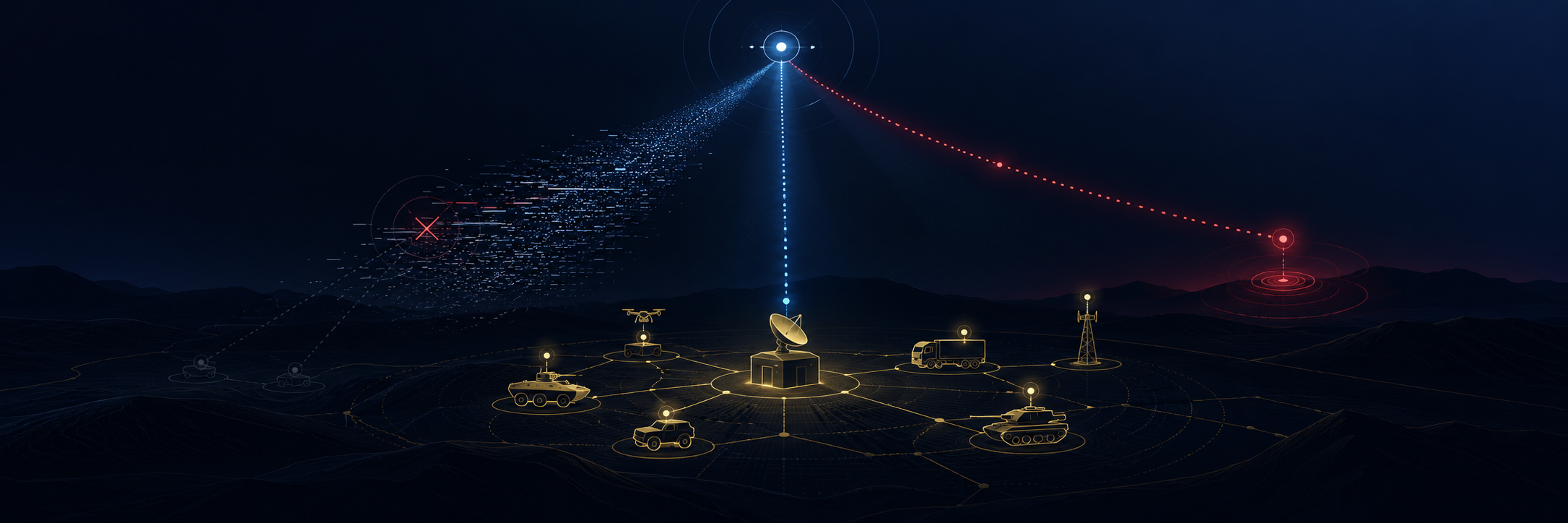
Most operations assume a signal from space that is always there and always right. That assumption is quietly becoming the single most contested point in the modern operating picture.
An enormous amount of modern activity runs on a faint signal from twenty thousand kilometers up — which is why GPS-denied operational risk mitigation has quietly become a core planning problem rather than a niche one. Position, navigation, and timing from satellite constellations do not just tell a vehicle where it is; they synchronize communications networks, timestamp financial transactions, coordinate logistics, and hold together operations that would not function if the signal drifted by microseconds. For most of that activity, the signal is simply assumed — always present, always accurate, never questioned.
That assumption is now the exposure. Denial and manipulation of satellite position and timing signals — through jamming that drowns them out and spoofing that quietly falsifies them — has moved from an exotic threat to a routine feature of contested environments, and increasingly of ordinary ones. GPS-denied operational risk mitigation is the discipline of planning for the moment the signal is not there, or worse, is there but lying: knowing which of your operations depend on it, what happens to each when it degrades, and how to keep functioning when the thing everyone assumed turns out to be the thing that failed.
For space and defense operators, and for the organizations that depend on space-based services without operating a single satellite themselves, this is no longer a scenario for the edge cases. It is a live exposure that belongs in the operating picture and in the risk program at the same time. It is one dimension of the broader satellite operational risk assessment platform — the discipline of reading a space-dependent operation’s exposures as one picture.
What is GPS-denied operational risk?
GPS-denied operational risk is the exposure an operation carries when the satellite position, navigation, and timing signals it depends on are jammed, spoofed, or degraded. It covers the obvious case — a platform that loses navigation — and the quieter one, where timing-dependent networks and logistics fail because the signal underneath was falsified. Mitigating it means mapping that dependency ahead of time.
GPS-denied operational risk mitigation starts with the failure you can’t see
The two ways a position-and-timing signal fails are not equally dangerous, and the more dangerous one is the one that does not announce itself. Jamming is loud: the signal is drowned out, the receiver knows it has lost the signal, and the operation at least understands that it is now navigating blind. It is disruptive, but it is honest about being a disruption.
Spoofing is worse precisely because it is quiet. A spoofed receiver does not know it has been compromised — it reports a confident, precise, and wrong answer, and every system downstream treats that answer as true. GPS jamming and spoofing risk reduction has to address both, but the spoofing case is where the real damage lives: an operation acting on false position or false time, with full confidence, until the consequences surface somewhere no one was watching. The most expensive failures are not the ones that look like failures.
Jamming takes the signal away and tells you it is gone. Spoofing leaves the signal in place and makes it lie. Planning for only the first is planning for the easier half of the problem.
The environment is not getting quieter. Interference with satellite navigation signals has become a routine condition across contested regions and a spreading one well beyond them, and the same commoditization of the tools that made spoofing exotic a decade ago has made it ordinary today. An operation that treated PNT denial as a wartime edge case is planning against a threat model that no longer matches the world it operates in.
This is why PNT disruption risk for space systems is a mapping problem before it is a technology problem. An operator cannot mitigate a dependency it has not identified, and position-and-timing dependencies hide in places that are easy to overlook — not just in the obvious navigation systems, but in the network synchronization, the timestamping, and the coordination layers that quietly assume an accurate clock from space. The first step is knowing where the assumption lives.
ReflexOS™ reads an operation’s dependence on satellite position and timing as part of one operating picture. It identifies where operations rely on a signal that could be jammed or spoofed, flags a degradation or a divergence that suggests the signal can no longer be trusted, and surfaces it for the operator’s discussion so the team can adjust — fall back to an alternate source, isolate the affected systems, or hold an action that depends on a position or time it can no longer verify. It does not prevent the jamming or the spoofing; it makes the operation’s exposure to them visible while there is still time to act. The operator decides; the platform makes sure the operator is not the last to know.
Used this way, space asset operational continuity is not a promise that the signal will always be there. It is the discipline of being ready for the times it is not — which, in a contested environment, is the only version of readiness that means anything.
Where the dependency hides
Position-and-timing dependence is rarely confined to the systems that obviously use a map. It gathers in places an operator may not have catalogued as space-dependent at all, and each rewards being seen as part of one risk picture.
The obvious case — platforms and vehicles that lose their position. Resilient positioning for defense operations starts here, but the visible dependency is rarely the whole of it.
The hidden case — networks and systems that need an accurate clock from space, not a map. Satellite timing dependency risk is where a signal failure cascades into systems no one classified as space-reliant.
Ground segment cyber risk assessment matters because the space signal is only half the system; the ground stations, links, and control systems that use it are their own attack surface — a cyber resilience question as much as a space one, where a compromise can look exactly like a signal problem.
Organizations that never launch anything still run on space-based timing and position. Space situational awareness risk assessment extends to anyone whose operations quietly assume the signal — which is very nearly everyone.
Read as one picture, these are the components of genuine GPS-denied operational risk mitigation: not a single backup receiver, but a mapped understanding of where an operation trusts a signal from space and a plan for each place it does — so a denial event is a managed condition rather than a discovery. The operators who handle a denied or spoofed signal well are rarely the ones with the most redundant hardware. They are the ones who knew, before it happened, exactly which of their operations leaned on that signal and what each would do without it. Preparation of that kind is cheap against the cost of learning it live.
Because that exposure is also an insurable one, the operational picture and the risk program belong together. Third-party liability from a launch is its own question — one that sits with aviation and space liability coverage rather than here — but the continuity exposure from a denied or spoofed signal is one a well-structured program should contemplate directly, placed with underwriting partners who understand what a contested PNT environment actually does to an operation.
The signal from space is the assumption almost nobody writes down. GPS-denied operations planning is the work of writing it down — and deciding what you do the day it stops being true.
The signal from space is the assumption most operations never map — until it is jammed or spoofed. U.S. Aerospace Defense Group pairs the ReflexOS™ operating picture, which surfaces where an operation depends on satellite position and timing, with senior brokerage that places the continuity exposure with underwriting partners who understand a contested PNT environment. See the dependency before it is tested.
#GPSdenied #PNT #SpaceInfrastructure #SatelliteRisk #Jamming #Spoofing #ResilientPNT #SpaceSituationalAwareness #DefenseOperations #OperationalContinuity #GroundSegment #ReflexOS #RiskIntelligence #SpaceSecurity #SDVOSB #USADG #IntelligenceBrief