
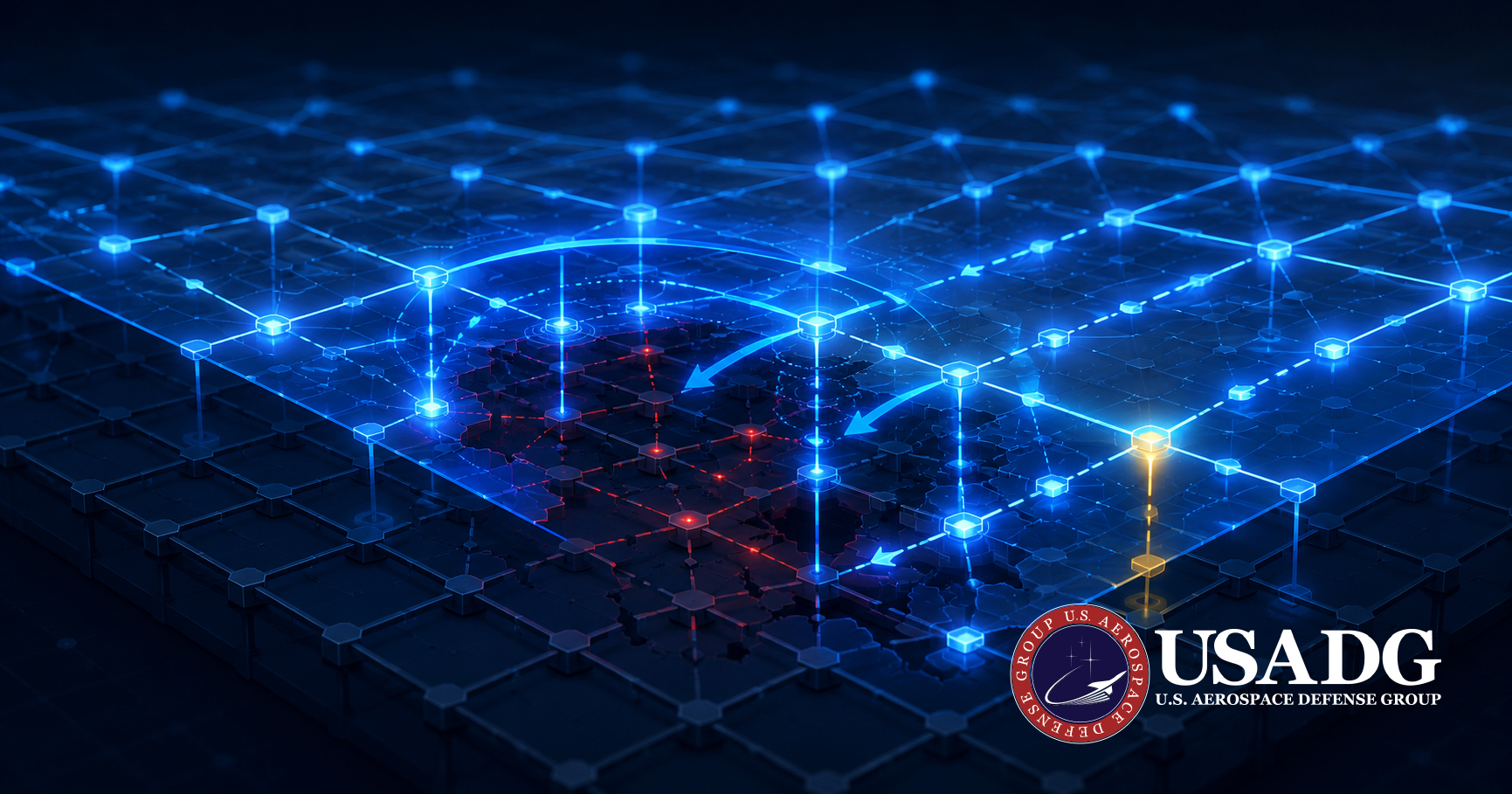
Prevention eventually fails. What separates an incident from a catastrophe is what happens in the hour after — and whether the systems you cannot take offline can absorb the hit and keep running.
Every security program is built on a promise it cannot fully keep.
The promise is prevention: enough layers, enough controls, enough vigilance, and the attacker never gets in. It is a reasonable goal and worth investing in. It is also, as any CISO in the defense industrial base will tell you privately, a goal that gets breached eventually — by a zero-day, a compromised supplier, a credential that should have been revoked, or a controller running firmware that was old when the contract was signed.
Which is why the more useful question is not how do we make sure nothing gets through? It is what happens in the hour after something does? A real-time cyber resilience platform for critical infrastructure exists to answer that second question — to keep an operation running while it is under pressure, and to return it to stable footing fast when something knocks it sideways.
What is cyber resilience for critical infrastructure?
Cyber resilience for critical infrastructure is the ability to keep operating while under attack and to restore normal function quickly afterward. It assumes prevention will sometimes fail. Rather than focusing only on keeping attackers out, it measures how fast an organization detects a disruption, contains it, and returns to stable operation.
The systems you cannot take offline
The hardest problem in industrial and defense cybersecurity is not that operators do not know their legacy systems are vulnerable. They know. The problem is that the vulnerable system is also the system that cannot stop.
A programmable logic controller running a production line. A SCADA environment older than some of the engineers maintaining it. A ground station commanding an asset in orbit. A manufacturing cell whose downtime is measured in six figures per hour. These are the environments CISA keeps flagging — operational technology and industrial control systems that were designed for reliability and physical safety in an era when nobody expected them to be on a network at all, and which are now squarely in the targeting picture of state-aligned actors. A patient monitor mid-procedure in a hospital that cannot go on diversion — where the same problem becomes a question of patient safety, and of how fast a ransomware intrusion is detected and contained.
The conventional advice is to patch, segment, and modernize. All three are correct and all three are slow. Patching an IT server is a maintenance window; patching a controller inside a certified process may mean revalidation, downtime, and regulatory review. So the gap between “we know this is exposed” and “we have fixed it” stretches from weeks into years — and the operation runs, exposed, the entire time.
That gap is not a failure of will. It is the actual operating condition of most of the defense industrial base, and any security approach that does not account for it is describing a different industry.
The most exposed system in the plant is almost always the one that cannot be taken down long enough to fix. Any strategy that begins “first, take it offline” has already failed the operator it was written for.
Resilience is measured on the back half of the framework
NIST’s Cybersecurity Framework 2.0 organizes the work into six functions: govern, identify, protect, detect, respond, recover. Most security budgets concentrate on the middle — identify and protect. That is where the firewalls, the encryption, the identity management and the endpoint tooling live, and it is where the vendor market is loudest.
Resilience lives on the back half. Detect. Respond. Recover. Those three functions determine whether an intrusion becomes a footnote or a shutdown, and they are measured in units operators actually feel: dwell time before detection, time to contain, time to restore, hours of production lost. An organization can be excellent at protect and still be devastated, because the one thing that got through sat undetected for weeks and the recovery took nine days.
NIST’s ransomware guidance makes the same point from the other direction. The organizations that survive a ransomware event in good order are rarely the ones with the most impenetrable perimeter. They are the ones who detected the encryption early, isolated it, and had a rehearsed path back to operating — including the ability to keep delivering while the recovery ran.
Sigma Shield cybersecurity resilience strengthens cyber-physical systems by adding an intelligent monitoring and self-correction layer on top of the security tools an organization already uses. It observes system behavior, assesses health continuously, detects anomalies early, and helps restore operational balance quickly — improving uptime and reducing the impact of interference or attack. Firewalls, encryption, authentication, endpoint and network defenses all stay exactly where they are. Nothing is ripped out. Nothing is re-architected. The layer is additive, and it is available exclusively to USADG clients.
The mechanism worth naming is self-correction. Detection alone still leaves a human in a race against an event already in motion. A self-restoring cyber defense architecture shortens that race by helping the system find its way back to stable operation rather than simply announcing that it has left it. That is the difference between an alert and a recovery.
Cyber resilience without rip and replace
The reason this approach is adoptable at all is that it does not ask an operator to give anything up.
Every serious security transition in a critical-infrastructure environment runs into the same wall: the cost of the change, the downtime it requires, the re-certification it triggers, and the operational risk of the transition itself. Those costs are real, and they are why so many known exposures stay open for years. A proposal that begins with a rip-and-replace has, in practice, proposed nothing — because it will not be approved, and everyone in the room knows it.
A cybersecurity intelligence overlay for existing systems inverts that. It integrates with the stack already in place, running as a continuous telemetry-based cyber defense alongside the tools a client already trusts. There is no new backbone to stand up, no infrastructure change, no re-architecture of the network it protects. The operator keeps every control they have invested in and every process their people are trained on — and gains a layer of diagnostic insight and automated support on top.
This is the same principle behind the real-time operational intelligence platform that underpins everything USADG builds: augment the stack, never replace it. Applied to decisions, it produces ReflexOS™. Applied to defense, it produces the resilience layer.
Holding steady through the migration ahead
There is a second reason resilience matters right now, and it has a date on it.
Executive Order 14412, signed June 22, 2026, directs a national transition to NIST-approved post-quantum cryptography — and the Department of War’s own strategy, issued the following day, states that nearly every deployed military asset will be affected in some way. The practical consequence for the defense industrial base is a cryptographic migration of extraordinary scope, running across networks, weapon systems, space systems and edge devices over the next several years.
Migrations are when systems break. Not because the destination is wrong, but because the transition itself introduces instability into environments that were finally stable. Sigma Shield cybersecurity resilience is built to hold the operation steady through that kind of upgrade — continuous monitoring and rapid response while sensitive data and operations move onto new standards, so the modernization does not become the incident. The migration itself is covered in depth in our piece on post-quantum cryptography migration.
What a resilience layer watches
Resilience is not a single control. It is continuous attention across the places where a defense contractor’s exposure actually concentrates.
Cybersecurity for legacy industrial control systems that cannot be patched on an IT schedule — protection that arrives without requiring the controller to change.
The NIST 800-171 controls behind CMMC are the same ones underwriters weigh. Continuous visibility of that posture serves the contract and the coverage at once.
Exposure that enters through a vendor or subcontractor is the defining feature of defense industrial base cyber resilience — and the hardest thing to see from the prime’s seat.
Ransomware resilience is ultimately a continuity question: can the operation keep delivering while the recovery runs? Uptime under pressure is the measure that matters.
Posture is a coverage asset
There is a direct line between how a contractor’s cybersecurity posture actually stands and the terms on which its cyber coverage gets placed. Underwriters ask about controls, architecture, detection and recovery capability because those factors predict loss. A contractor who can demonstrate continuous cyber risk monitoring for defense contractors — rather than an annual questionnaire and a hope — presents a materially different profile to the market.
That is the second half of what USADG does. As a specialized independent insurance broker, it places cyber coverage with A-rated underwriting partners and advocates for clients on claims. It does not underwrite and it does not assume risk. What it brings is the pairing: the resilience layer that improves the posture, and the market access to place coverage against what remains. When posture monitoring surfaces an emerging exposure, the cadence is identify → flag → discuss → adjust — a conversation, not an automatic change. The coverage lines are set out on the USADG coverage page, and the compliance side of the same picture is covered in our piece on certification readiness for government contractors.
A stronger posture does not only reduce risk. It improves the terms on which the residual risk is placed.
Built to endure
The perimeter will hold most days and fail on one of them. That is not pessimism; it is the working assumption every mature security program is quietly built on. What distinguishes the organizations that come through intact is not that they were never hit. It is that when they were, the operation kept running and the recovery was measured in hours rather than weeks.
Resilience is what you have left when prevention runs out. It is worth building before you need it — and it is worth building in a way that does not require taking down the very systems you are trying to protect.
Physics-enforced cybersecurity resilience is not a stronger wall. It is the recognition that walls are the wrong unit of measurement — and that the only number that matters, on the day it matters, is how long it takes you to get back up.
U.S. Aerospace Defense Group provides Sigma Shield cybersecurity resilience — a monitoring and self-correction layer that deploys on top of the security stack you already run, with no rip-and-replace — and, as a specialized independent broker, places matching cyber coverage with A-rated underwriting partners.
#CyberResilience #SigmaShield #CriticalInfrastructure #OTSecurity #ICSSecurity #LegacySystems #NISTCSF #RansomwareResilience #OperationalContinuity #DefenseIndustrialBase #CMMC #NIST800171 #CyberInsurance #GovCon #DefenseContractor #SupplyChainSecurity #PostQuantum #EO14412 #USADG #SDVOSB #BuiltToEndure #IntelligenceBrief