
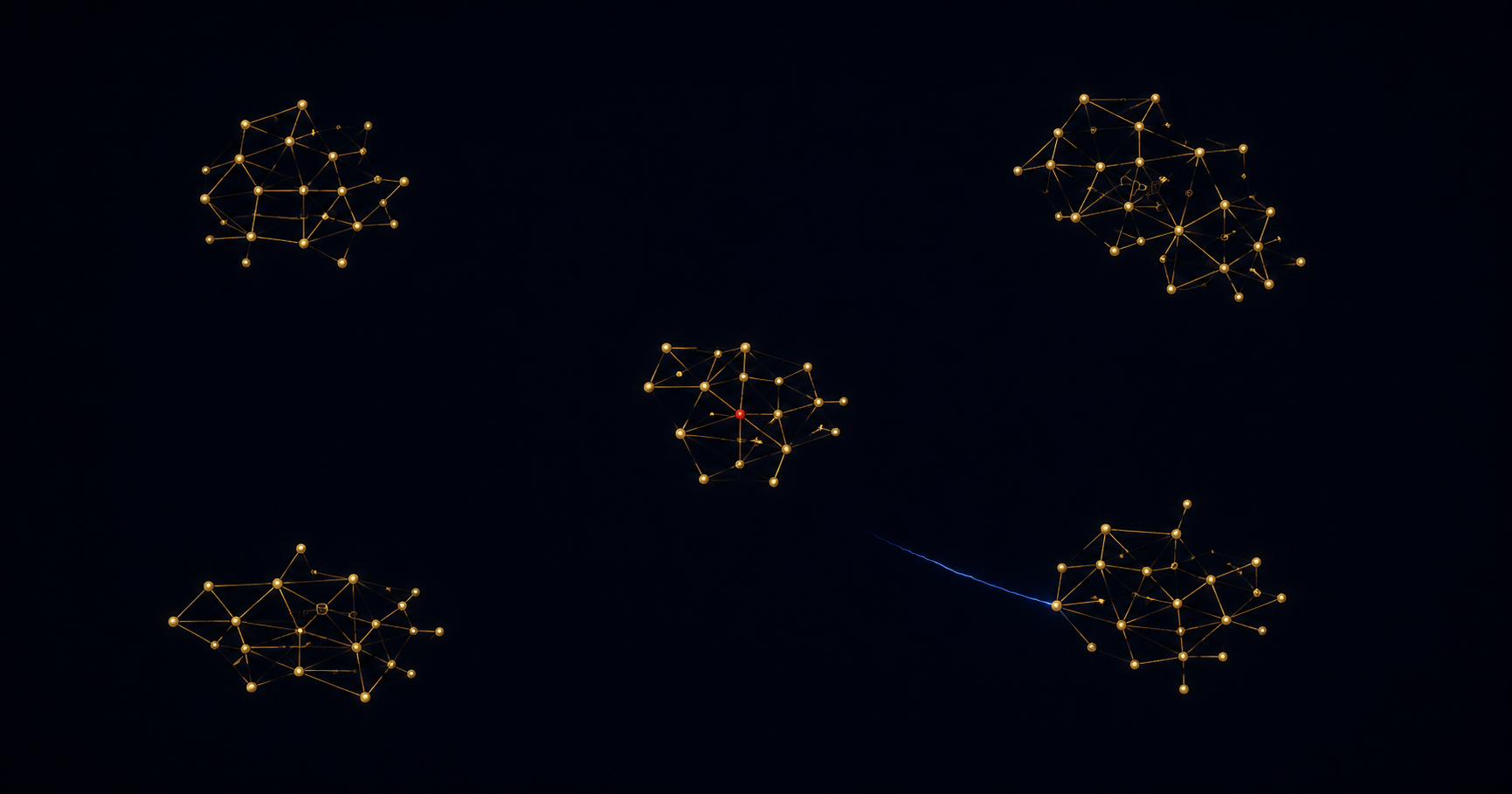
Operators run a control network, a business network, a commercial stack, a safety layer and an integrity program — each competently managed, none looking at the same picture.
On May 7, 2021, Colonial Pipeline learned it had ransomware. Within the hour it shut down 5,500 miles of pipeline carrying nearly half the East Coast’s fuel.
The attack never reached the pipeline. The company’s chief executive later told the Senate there was no evidence the intrusion had touched its operational systems at all.
The case for real-time operational risk intelligence for oil and gas is written into that gap, and it has almost nothing to do with stopping attacks.
The ransomware was in the enterprise network. The control systems were, as far as anyone could establish, clean. Colonial shut down anyway — partly to keep the malware from crossing into operational technology, and partly because the billing systems needed to move product had gone dark. Both were sound decisions. Neither was an informed decision, because the information required to make one informed did not exist in any single place, and could not be assembled in fifty-five minutes.
What is operational risk intelligence in oil and gas?
Operational risk intelligence in oil and gas is the continuous fusion of signals from control, integrity, safety, cyber and commercial systems into a single live operating picture — so that risk is assessed against the actual state of the asset rather than against whichever system is reporting. It shortens the interval between an event and an informed decision about it.
The shutdown was a visibility decision, not a security decision
Reconstruct the fifty-five minutes and the structural problem becomes obvious.
A ransom note appears on a machine in the enterprise network. The question the operator now has to answer is narrow, specific and urgent: has this reached the control network, and can I prove it hasn’t, right now?
Answering that requires knowing, in the same moment: what is running in the control environment; whether anything anomalous has crossed the boundary between the business network and the operational one; whether the historian, the engineering workstations and the remote-access paths are clean; and whether the commercial systems the operation depends on are still functioning. Five questions, five systems, five owners, and — in most operators — five separate screens in five separate rooms, several of which are only reconciled at the end of the month. Defending that boundary — the crossing point between the business network and the operational one — is the subject of the oil and gas OT cybersecurity platform.
An operator who cannot answer that question in the first hour has exactly one responsible option, and it is to shut down. Not because the risk is known to be high, but because the risk is unquantified, and an unquantified risk in a hydrocarbon system is treated — correctly — as a large one.
The risk that shuts you down is the one no single system was watching.
Which means the shutdown was not really caused by ransomware. It was caused by the fact that no one could see the whole asset at once. The ransomware was the trigger; the blind spot was the mechanism. And a blind spot does not care what pulls it — a cyber event, a false positive on a leak detection system, an integrity anomaly nobody can immediately correlate, a supplier failure. The next trigger will be different. The mechanism will be identical.
Five systems, five owners, no picture
The pipeline and refinery risk intelligence platform problem is not a shortage of data. Operators are drowning in data. The problem is that the data lives in domains that were built by different people, at different times, to answer different questions, and that nobody ever asked to reconcile.
Flow, pressure, valve state, compressor and pump status. Purpose-built, well-instrumented, and deliberately walled off from everything else — which is exactly why it cannot tell you what is happening on the other side of the wall.
In-line inspection runs, corrosion monitoring, cathodic protection, thickness readings, fitness-for-service. Rich, rigorous — and reported on a cycle measured in months while the asset degrades continuously.
Safety instrumented systems, alarm management, process safety indicators under API RP 754, management-of-change. Designed to act on the asset, not to explain it to anyone outside the plant.
Enterprise security, remote access paths, vendor connections, the historian sitting astride the boundary. The seam where Colonial’s problem lived — and the seam almost nobody monitors as a single continuous surface.
Nominations, batch scheduling, measurement, billing. The system that stopped Colonial’s product moving even though the pipe itself was fine. Almost never modeled as an operational dependency. It is one.
PHMSA reporting, API 1173 safety management, TSA directives on the pipeline side, BSEE offshore, DOE-driven methane measurement and verification. Each with its own clock, its own auditor, its own consequence.
Every one of those six is well run. That is the uncomfortable part. There is no negligent domain in the list, no obvious place to point. The failure is not in any of them — it is in the space between them, which is nobody’s budget line and nobody’s job title.
Asset integrity is a data problem before it is a metal problem
The same seam runs through the physical side of the business, and it costs money there every single year rather than once a decade.
An oil and gas asset integrity monitoring platform exists because degradation is continuous and inspection is periodic. Corrosion does not wait for the next in-line inspection run. A compressor’s bearing signature drifts for weeks before anything trips. A relief valve’s history, its last test, its process conditions and its criticality all exist — in four systems, none of which is looking at the other three.
Which is where the real opportunity to reduce unplanned downtime in oil and gas sits. Not in the thing nobody knew — in the thing three people each knew a third of.
ReflexOS™ is an overlay, not a replacement. It provides operational intelligence for existing SCADA systems — reading what the control environment already produces, alongside integrity, safety, cyber and commercial telemetry, and resolving all of it into one live picture. Nothing is ripped out. Nothing is re-platformed. Identify the correlated signal. Flag it to the control room, the integrity lead and the risk owner at the same moment. Discuss it against the actual state of the asset. Adjust deliberately. The evidence arrives earlier. The decision stays with the operator.
The reason the overlay model matters here more than anywhere else is that this industry cannot rip and replace. A refinery’s control system is a safety-certified installation with a twenty-year life and a change process that involves regulators. Any proposal that begins with first, replace your SCADA is not a proposal; it is a fantasy with a price tag. The picture has to be built on top of what is already running, or it does not get built.
What real-time operational risk intelligence for oil and gas would have shown that morning
It is worth being concrete, because the counterfactual is where this argument either earns its keep or collapses into vendor noise.
Nothing about a unified operating picture would have stopped the ransomware. The credential was compromised weeks earlier, on a legacy remote-access path without multi-factor authentication, and no amount of correlation downstream repairs an unrevoked account upstream. Any vendor who says otherwise is selling.
What changes is the first hour. At 5:00 a.m. the operator’s question was: has this crossed into control? With five systems and five owners, that question takes days to answer and the only safe answer in the meantime is to stop. With one picture, it is a question you interrogate rather than a question you flee — the boundary traffic, the historian’s behavior, the engineering workstations, the remote sessions, the control network’s own state, all in one view, reconciled to the same clock.
The answer might still have been shut it down. Sometimes the honest read of the evidence is that the exposure is real and the asset comes off line, and a picture that only ever tells you to keep running is not a risk tool, it is a sales tool. But it would have been a decision made against evidence rather than against the absence of it — and the difference between those two things, priced across six days of a pipeline that moves nearly half a region’s fuel, is not a rounding error.
That is the entire proposition. Not fewer incidents. Shorter intervals between the incident and the understanding of it — which is the only variable in this business that an operator can actually move.
The regulators already drew this conclusion
One useful test of whether an argument is real: check whether the people with subpoena power reached it first.
They did. In the weeks after Colonial, the TSA issued security directives to pipeline owners and operators — among the first requirements of which was that each designate a cybersecurity coordinator available around the clock, reachable at any hour. Read that as a technical control and it looks modest. Read it as a diagnosis and it is devastating: the federal government’s first instinct, after watching the largest fuel pipeline in the country stop, was to legislate the existence of a person who could be found. The gap was not a firewall. The gap was that nobody could get an answer.
API 1173 makes the same argument from the industry’s side, and made it earlier — that pipeline safety has to run as a management system rather than a collection of well-executed tasks, because tasks completed in isolation do not compose into safety. PHMSA’s reporting regime encodes it from a third direction. BSEE does it offshore. Every one of these frameworks was written by people who could not assume an operator had a unified picture, and who built their requirements around that assumption.
The frameworks are the scar tissue. They are what the industry grew where the seam kept tearing.
Where the picture becomes a capability
Visibility on its own is a dashboard, and this industry already owns more dashboards than it can staff. What an operator actually needs is two things — and they have historically been bought from two different kinds of company, on two different budgets, and never made to agree.
ReflexOS™ is the operating picture. It reads what the control environment already produces, alongside integrity, safety and commercial telemetry, and resolves the whole estate into one live view. It is an overlay, so nothing is ripped out, and it is built to shorten exactly the interval Colonial could not shorten: the one between an event and an informed answer about what the event actually touched.
Sigma Shield cybersecurity resilience covers the seam that event lived in — the IT/OT boundary, the remote-access paths, the vendor connections, the historian sitting astride the divide. Not as a security product bolted on beside an operations product, but as the same conversation, because the boundary is where the operational question and the security question turn out to be one question wearing two badges.
Bought separately, they do not compose. The security team instruments the boundary and reports to one committee. The operations team instruments the process and reports to another. Each does its job well. And on the morning it matters, the control room still cannot answer has this crossed into control — because the two halves of the answer are sitting in two rooms, and the person who needs them is in a third.
Bought together, they are a single instrument pointed at a single exposure. The picture that shortens the first hour is the same picture that proves the resilience posture a regulator will ask about, and the same picture the real-time operational intelligence platform was built to produce in the first place. The cyber resilience posture and the operational one are two views of the same asset.
This is not a bundling argument. It is an observation that they were always the same problem, purchased separately for historical reasons rather than good ones — and that the seam between them is precisely where the industry keeps losing six days at a time.
The same structural gap runs through every heavily instrumented, safety-critical, OT-dependent industry. It is why freight rail faces a nearly identical problem with a different set of acronyms, and why the answer in both cases starts with the same question: who is looking at all of it at once?
The pipeline was fine. The control systems were fine. What failed was the ability to know it — and that cost the East Coast its fuel for six days.
U.S. Aerospace Defense Group works with pipeline, refining and upstream operators on both halves of the same problem — the ReflexOS™ operating picture across control, integrity, safety and commercial systems, and Sigma Shield cybersecurity resilience at the IT/OT boundary. Demonstrations available, on your estate, against your own telemetry.
#OilAndGas #PipelineSafety #AssetIntegrity #OTSecurity #ICS #SCADA #OperationalIntelligence #ReflexOS #SigmaShield #ProcessSafety #PHMSA #API1173 #UnplannedDowntime #CriticalInfrastructure #EnergySecurity #SDVOSB #USADG #IntelligenceBrief