
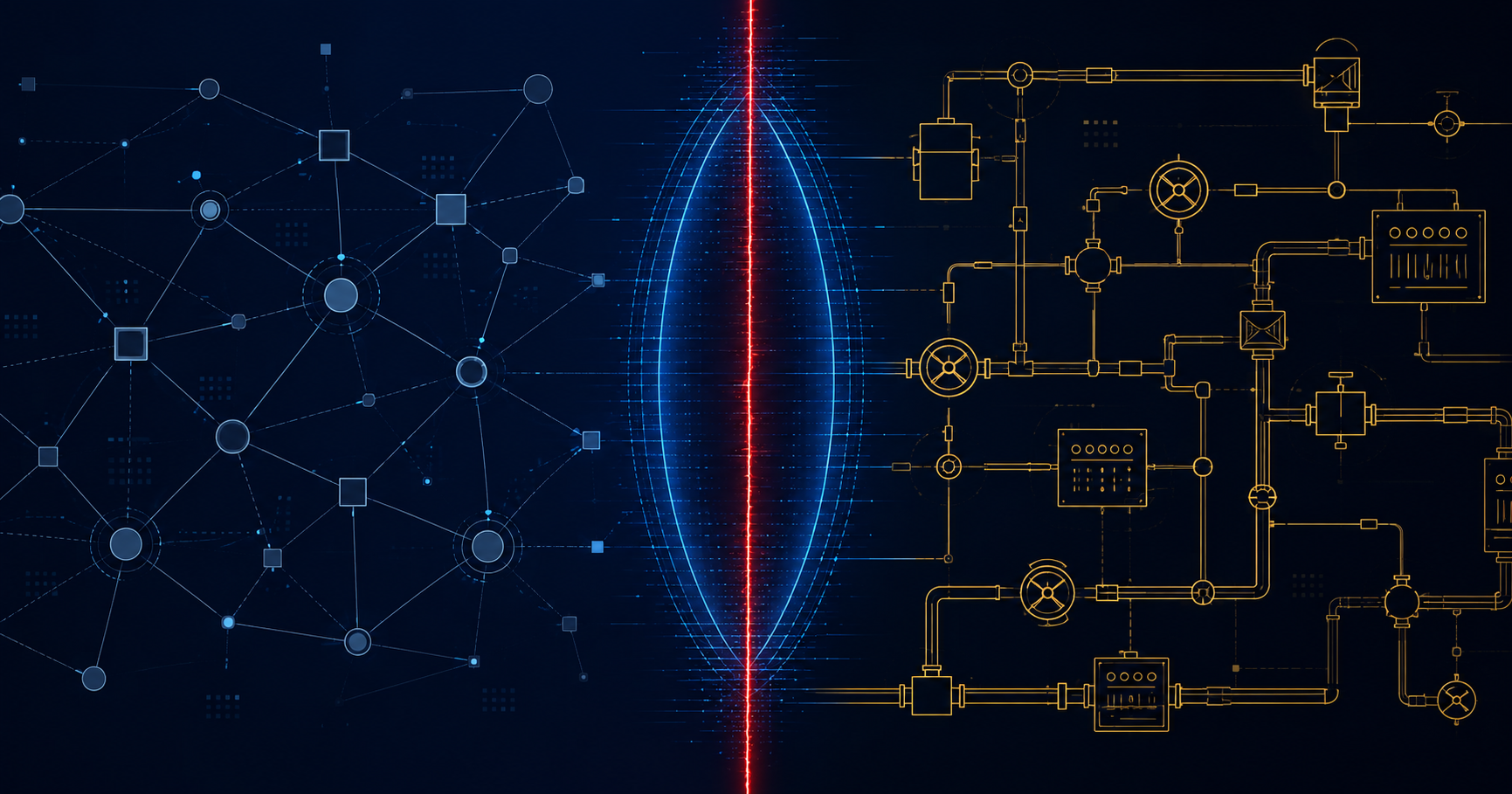
The control system that runs a pipeline was designed to be reliable, not to be attacked. For most of its life those were the same requirement. They are not anymore.
A modern pipeline, refinery, or offshore platform runs on two networks that were never really meant to meet — which is the whole reason an oil and gas OT cybersecurity platform is a distinct discipline rather than a line item in an IT budget. One is the ordinary IT network: email, business systems, the internet. The other is the operational technology that actually moves the product — the SCADA systems, the programmable controllers, the sensors and valves that turn a command into a physical action in the world.
For decades those two worlds were separated by a genuine air gap, and the operational side was protected mostly by being unreachable. That protection is gone. The efficiencies of a connected operation pulled IT and OT together, and the seam where they now meet is precisely where the risk concentrates. An oil and gas OT cybersecurity platform exists to defend that seam — not the office network a generalist tool already watches, but the control systems where a breach stops being a data problem and becomes a physical one.
That is the distinction that matters in this sector. When the target is operational technology, the worst outcome is not a leaked database. It is a shut-in well, a tripped refinery, a pipeline that stops — or worse, one that keeps running while its operators have lost the ability to see or trust what it is doing.
Regulators have caught up to that reality. CISA treats the energy sector as critical infrastructure whose compromise carries national consequences, and PHMSA’s pipeline oversight increasingly recognizes that a control-system intrusion and a physical integrity failure can be the same incident. The compliance direction of travel is unambiguous: OT security is no longer a discretionary hardening project but an expected posture — and the operators who treat it that way are the ones who will not be scrambling to explain a preventable shutdown after the fact.
What is operational risk intelligence in oil and gas?
Operational risk intelligence in oil and gas is the practice of reading an operation’s technical, physical, and cyber signals together, in real time, to see risk forming across systems usually monitored separately. It spans asset integrity, process conditions, and control-network security — so a boundary threat or a failing asset is visible as one picture, not buried in a siloed system.
Why an oil and gas OT cybersecurity platform defends the boundary, not the inbox
Almost every serious operational-technology intrusion follows the same path: the attacker enters through the IT side, where the human beings and the internet connections are, and moves laterally toward the OT side, where the physical process lives. The IT network is the door. The OT network is the target. Understanding that path is what separates a defense built for the operation from one built for the office — the attacker’s route runs toward the physical process, and so must the defense that means to meet it.
This is why pipeline SCADA cybersecurity monitoring cannot be an afterthought bolted onto an IT security stack. The controls that protect a spreadsheet are not the controls that protect a compressor station, and the signals that reveal an intrusion into a control system look nothing like the signals a conventional security tool is trained to see. Defending the operation means watching the boundary itself — the crossing point — with something built to understand what normal looks like on the OT side and to notice, early, when something stops being normal.
Sigma Shield defends the IT/OT boundary with a physics-enforced, geometry-locked, mathematically grounded architecture — a resilience model built on the structure of the system itself, not on a list of the attacks seen so far.
That last distinction is the heart of it. A security model built on a catalog of known attacks is always one step behind the attack it has not catalogued yet. A resilience model built on the structure of the system — on what the operation is architecturally permitted to do — does not depend on having seen the specific threat before. For a control system, where the cost of being one step behind is measured in physical consequences, that difference is the entire argument.
ReflexOS™ reads an operation’s process data, asset-integrity signals, and OT-network behavior as one live picture. It identifies where a cyber event and a physical anomaly are the same story — an unexpected controller command, a sensor reading that no longer matches the process it describes — flags it while there is still time to respond, and surfaces it for the operator’s discussion so the team can adjust. Paired with Sigma Shield at the IT/OT boundary, the operation gets both halves: the resilient architecture that holds the line, and the operating picture that sees the whole event. The response stays with the people who run the plant.
This is the two-part logic of the offer. Cyber resilience for pipeline operations is not only a stronger wall; it is a wall paired with a window — the architecture that resists the intrusion, and the intelligence layer that lets the operator see the intrusion and the physical process as a single connected event. The operating picture behind that window is the real-time operational intelligence platform, and the resilience architecture itself is the same one described in the real-time cyber resilience platform for critical infrastructure.
The reason the two belong together is that neither is sufficient alone. A resilient boundary with no operating picture holds the line but leaves the operator blind to what the intrusion was doing to the physical process; an operating picture with no resilient boundary sees the event clearly but cannot stop it. Paired, they let an operator both hold the line and understand the whole event — which, when a control system is the target, is the difference between a contained incident and a shutdown explained in hindsight.
Where the risk actually lives
Operational-technology risk in oil and gas is not one exposure. It gathers in a few specific places, and each one rewards being watched as part of the whole rather than in isolation.
Geographically dispersed control with remote sites that are hard to watch and easy to reach. Pipeline integrity monitoring platform capability matters most where a cyber event and a physical integrity event can look identical until someone reads them together.
Dense, interconnected control where a single manipulated setpoint has consequences. A pipeline and refinery risk intelligence platform reads process behavior and network behavior together, because in a refinery they are the same safety question.
Oil and gas asset integrity monitoring platform work overlaps with security more than most operators expect: the same anomaly detection that catches a failing asset early can catch a control system behaving in a way its physics says it should not.
Operational intelligence for existing SCADA systems matters because most operators cannot rip out and replace decades of control infrastructure. The resilient layer has to work with the systems already installed, not demand their replacement.
Read as one picture, these are the components of reduce unplanned downtime in oil and gas from the direction operators most often miss: not just better maintenance, but a security posture that keeps a preventable cyber event from becoming an unplanned shutdown.
The pipeline does not care whether the thing that stopped it was a failed valve or a forged command. Defending the operation means being able to tell the difference — and being ready for both.
In oil and gas, the intrusion that matters ends at the control system, not the inbox. U.S. Aerospace Defense Group brings two capabilities to that problem together — Sigma Shield resilience at the IT/OT boundary, and the ReflexOS™ operating picture that reads process, asset, and network signals as one event — so an operator can defend the operation and see it clearly at the same time.
#OTsecurity #OilAndGas #SCADA #ICSsecurity #CriticalInfrastructure #PipelineSecurity #CyberResilience #SigmaShield #OperationalTechnology #RefinerySecurity #AssetIntegrity #ReflexOS #CISA #PHMSA #EnergySecurity #SDVOSB #USADG #IntelligenceBrief