
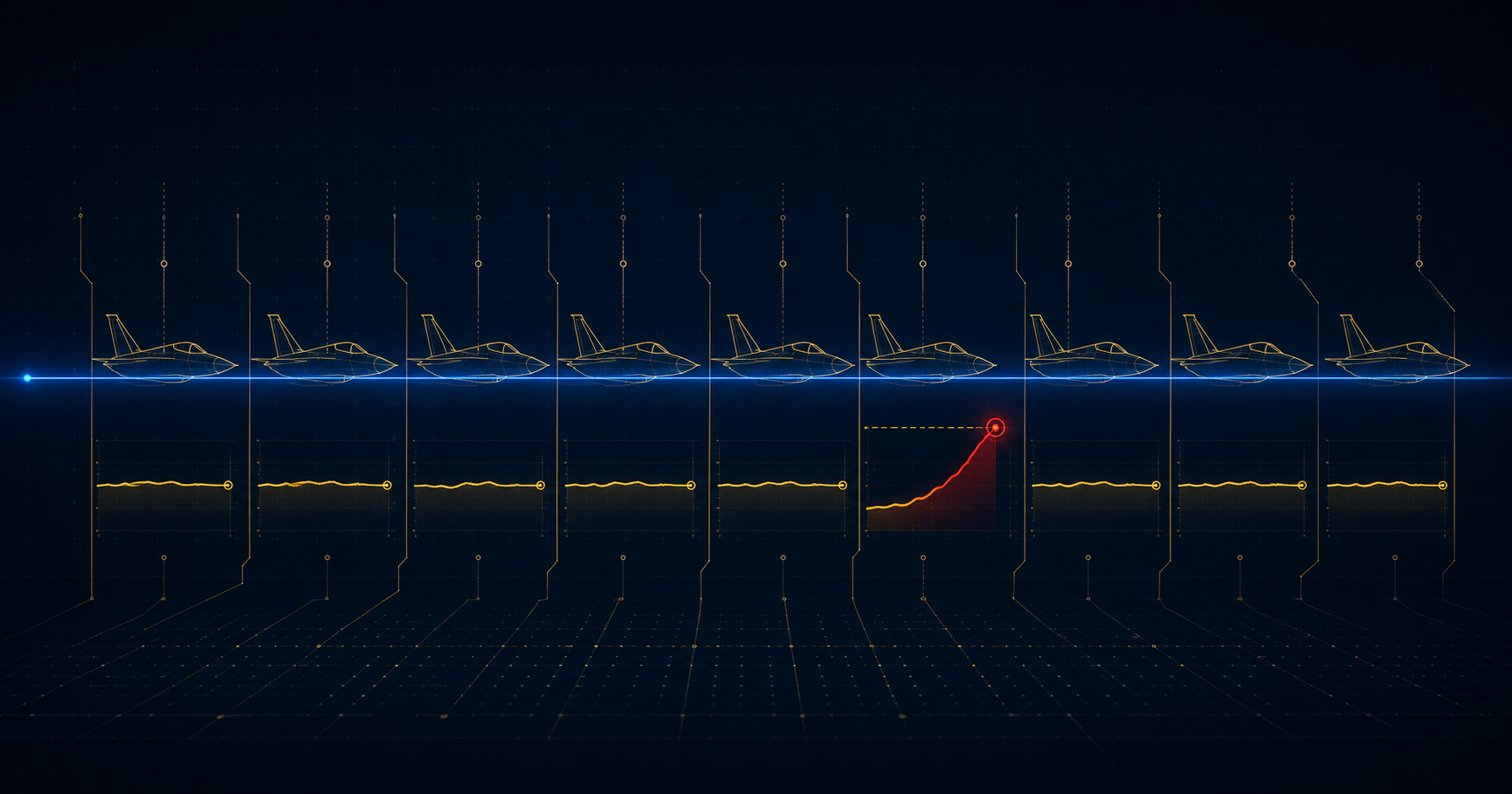
Readiness is usually discussed as a budget line. It is really a prediction — a bet, renewed every day, about which systems will start when they are needed and which will not.
Most of what a weapon system costs, it costs after it is bought — which is why predictive maintenance analytics for defense readiness has become a sustainment priority. Acquisition is the down payment; sustainment — the decades of maintenance, spares, overhauls and repairs that keep a platform mission-capable — is the mortgage, and it routinely runs to a multiple of the purchase price.
The uncomfortable part is how much of that spending is timed by failure. A component breaks, a system goes down, and the repair happens on the failure’s schedule rather than the operator’s. Predictive maintenance analytics for defense readiness exists to change what sets that timing — to move maintenance from a reaction against breakdown toward a decision made on evidence, before the platform is already down.
The distinction is not academic. A fleet that maintains on a fixed calendar wastes life on parts that were fine; a fleet that maintains on failure loses availability exactly when it can least afford to. Both are expensive. The question is whether the data a platform already generates can narrow the guess in between.
What is predictive maintenance in defense sustainment?
Predictive maintenance uses a platform’s own sensor and maintenance data to estimate when a component is likely to fail, so it can be serviced on evidence rather than on a fixed schedule or after a breakdown. In a defense context the goal is readiness: a higher, more predictable share of the fleet available when required.
Why predictive maintenance analytics for defense readiness changes the math
Sustainment is measured in dollars, but it is judged in readiness — the mission-capable rate, the share of a fleet actually available to operate at a given moment. A program can hit every cost target and still fail the only test that counts, because the aircraft or vehicles are not ready when they are called.
This is where the economics get counterintuitive. Beyond a point, spending more on maintenance stops buying readiness and starts buying activity — inspections that find nothing, parts replaced before their time, labor consumed on the wrong things. Mission capable rate analytics platform work is about finding where a maintenance dollar actually converts into availability and where it merely converts into motion. The two are not the same, and telling them apart requires seeing the fleet’s condition as it is, not as the maintenance calendar assumes it to be.
The most expensive maintenance is not the repair you make too late. It is the hundred you made too early, on parts that would have been fine — and the readiness you spent chasing them.
That is the promise of weapon system sustainment cost analytics: not simply to cut the maintenance bill, but to spend it where it converts to availability — to make the same budget buy more ready aircraft, or the same readiness cost less.
The signal is already there — it is just not assembled
Modern platforms are dense with instrumentation. Engines, avionics, hydraulics and structures all generate condition data continuously. Maintenance systems record every fault, every part, every hour. Supply systems track what is on the shelf and what is on order. The information needed to anticipate a failure usually exists somewhere in that estate before the failure happens.
What is missing is rarely the data. It is the fusion — the layer that reads condition telemetry, maintenance history and supply status together and resolves them into one forward-looking picture, the same overlay principle described in the real-time operational intelligence platform. A rising vibration signature means one thing on its own; combined with a maintenance record showing the same component trending across the fleet, and a supply system showing the replacement part is not stocked, it means something far more urgent. Condition-based maintenance plus analytics is the discipline of reading those signals together, early enough to act while acting is still cheap.
ReflexOS™ reads condition telemetry, maintenance history and supply status as one live picture of fleet readiness. It identifies the component trending toward failure, flags it while there is still lead time to source the part and schedule the work, and surfaces it for the maintener’s discussion so the program can adjust deliberately. It raises the warning earlier and sharpens the odds; it does not replace the judgment of the people who own the aircraft. The decision to pull a platform for service stays where it belongs.
The value is measured in lead time. A fault flagged weeks out is a scheduled task with the part already on order; the same fault discovered at failure is an aircraft down, a part expedited at a premium, and a readiness gap while both are resolved. Real-time sustainment and readiness intelligence is the difference between those two versions of the same event.
Where readiness is won or lost
The same analytics discipline reads different failure modes across the sustainment enterprise — and the highest-value signals are often the ones that cross system boundaries.
Vibration, temperature and performance drift that precede a mechanical failure. Read early, a degrading component is a planned task; read late, it is an unplanned removal and a grounded platform.
Military spare parts availability monitoring matters because a predicted failure is only actionable if the part exists. The forecast and the shelf have to be read together, or the warning arrives without a remedy.
Diminishing manufacturing sources risk monitoring catches the slower failure: the part still works, but the only supplier is exiting, and the platform’s remaining service life now outlasts its own supply chain.
A readiness degradation early warning system watches the trend no single aircraft reveals: the same component softening across the fleet at once, a systemic problem visible only when the platforms are read together.
Reading those together — condition, supply, obsolescence and fleet trend — is what fleet readiness and lifecycle cost optimization actually requires. Any one of them in isolation produces a partial picture, and a partial picture is how a fleet ends up cash-rich in spares it does not need and short the one part that grounds a squadron.
Where readiness meets the risk program
There is a connection between how well a contractor sustains a fleet and how it is seen by the market that insures it — and most sustainment teams never make it.
A contractor that can demonstrate control over its readiness — that can show condition-based evidence, a managed supply tail, and a track record of anticipating failures rather than reacting to them — is describing a lower-variance operation than one that cannot. That difference is the language an underwriter speaks. The same forward-looking picture that keeps a fleet ready is also the evidence that a program is well-run, and a well-run program is a different risk.
USADG is a specialized independent insurance broker to the aerospace and defense community. For the contractors and sustainment operations it serves, it places and structures program and liability coverage with A-rated underwriting partners, and it advocates for clients on claims. The readiness picture is where the operational case is built; the coverage program is where the residual risk is transferred; and the same evidence supports both. The lines are set out on the USADG coverage page, and the broader operating picture behind them is the defense sustainment cost and readiness analytics platform.
Readiness is not bought at the depot on the day it is needed. It is accumulated, quietly, in every decision to act on a warning while the platform was still flying.
Readiness is accumulated in the warnings a program acts on early. U.S. Aerospace Defense Group works with defense contractors on the picture and the program together — the ReflexOS™ readiness view that reads condition, maintenance and supply as one forward-looking signal, and, as a specialized independent broker, the coverage placed and structured against the risk a well-run sustainment operation actually carries.
#PredictiveMaintenance #DefenseReadiness #Sustainment #MissionCapableRate #ConditionBasedMaintenance #FleetReadiness #DMSMS #SparePartsAvailability #LifecycleCost #ReadinessAnalytics #DefenseLogistics #GovCon #ReflexOS #OandS #WeaponSystemSustainment #SDVOSB #USADG #IntelligenceBrief