
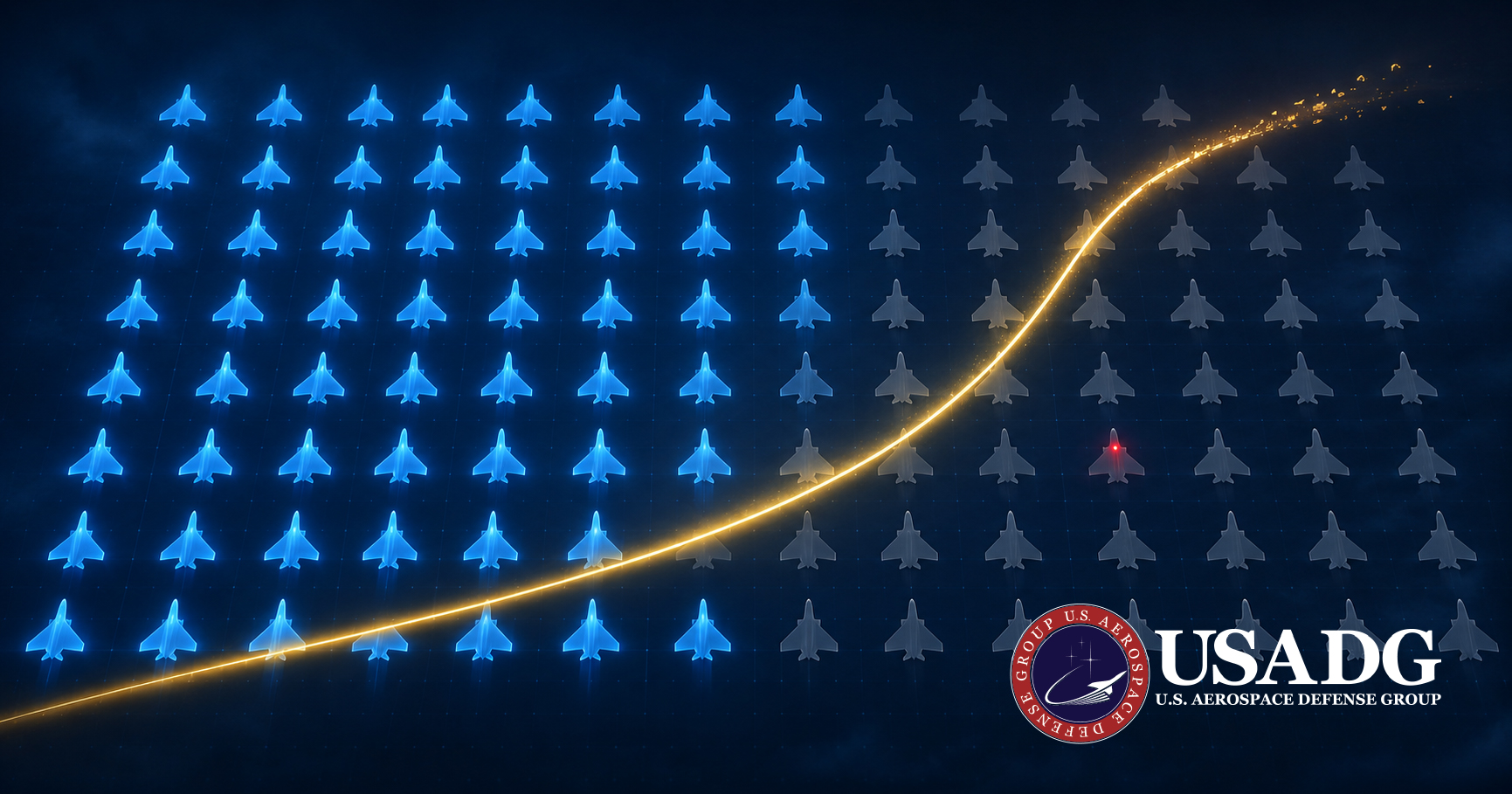
The acquisition price is the number everyone argues about. Operating and support is the number that decides whether the program is affordable — and it is roughly 70 percent of the total.
Every defense program is fought over at the front end. The unit cost, the award, the protest, the headline figure that lands in a committee hearing. That is the number the public sees and the number that gets litigated.
It is also the smaller number. Across a weapon system’s life, the money that actually gets spent is spent on keeping it running — and that is why defense sustainment cost and readiness analytics belong in the same conversation as the award, not in a maintenance office three floors down from it. Readiness is an operational outcome. It is also, unavoidably, an economic decision.
What are operating and support costs in defense?
Operating and support costs are what it costs to run and maintain a weapon system after it has been fielded — repair parts, depot and field maintenance, contract services, engineering support and personnel. They are incurred across the system’s entire service life, and according to GAO they account for approximately 70 percent of its total life-cycle cost.
What drives weapon system sustainment costs?
Sustainment costs rise mainly when a system stays in service longer than planned, when it is fielded in greater numbers, when new capability is added, or when operational tempo increases. Costs also grow when earlier estimates simply omitted things — spare parts, maintenance, upgrades — that later turn out to be unavoidable.
Seventy percent changes the argument
That single figure — approximately 70 percent of total life-cycle cost — should reorganize how a program is discussed, and in most organizations it has not.
It means the decision that determines a program’s affordability is very often not the one made at award. It is the accumulation of a thousand smaller ones made afterward, over decades: how the fleet is maintained, how spares are positioned, how long the platform stays in service, how much of its cost is visible early enough to manage. Defense operating and support cost analytics are not a back-office function attached to a program. They are the program, viewed over its actual life rather than its first year.
And they are the reason readiness and cost cannot be separated. An aircraft that is not mission capable is not merely unavailable — it is still being paid for. Every point of availability recovered is capability returned to the schedule without buying anything new. Every point lost has to be bought back somewhere more expensive, or simply goes.
Availability is the cheapest capacity a fleet has — it’s the aircraft you already own, returned to the flight line. Everything lost to a late signal or a misplaced spare is capacity you then have to buy somewhere more expensive.
The cost growth is structural, not accidental
GAO’s most recent review of DoW sustainment is worth reading carefully, because it does not describe a management failure. It describes a pattern.
Across 36 weapon system sustainment reviews covering fiscal years 2023 and 2024, DoW identified 14 systems with critical operating and support cost growth — meaning at least a 25 percent increase over the most recent independent cost estimate, or at least 50 percent over the original baseline. Not a rounding error. A different program than the one that was funded.
The causes are the part that matters, because they recur. Twelve of the fourteen involved extensions to the service or program life. Others involved increased quantities, added capability, higher operational tempo — and a category GAO names plainly: previously omitted costs. Maintenance, spare parts and upgrades that were simply not in the original estimate.
Read that list again and notice what it is not. It is not incompetence. Extending a platform’s life because the replacement slipped is an operational necessity, not a mistake. But it does mean that sustainment cost growth is largely predictable in kind, even when it is not predicted in practice — and something predictable in kind is something an operator can watch for.
And the reporting is about to get thinner
Here is the development that should concentrate the mind of anyone in this business.
The GAO review described above was the final one required under the congressional mandate that has driven this reporting since 2021. A provision in the National Defense Authorization Act for fiscal year 2026 eliminates the requirement for the Pentagon to report detailed cost-growth data in future sustainment reviews.
Whatever the merits of that decision, its practical effect is unambiguous: the shared, public, comparable picture of where sustainment costs are running away is going to get dimmer. The instrument that told everyone — Congress, the services, the industrial base — which programs were in trouble is being switched off.
Which leaves an operator with a straightforward conclusion. If the official telemetry is fading, the only telemetry you can count on is your own. An organization that has built real-time visibility into its own sustainment economics will keep seeing clearly. One that was relying on the annual report to tell it where the problems were is about to find out how much it had outsourced.
ReflexOS™ gives sustainment operators real-time continuity and availability visibility — fusing maintenance telemetry, spares and logistics data into a live operational picture on top of the fleet systems they already run. It surfaces disruption early, so a developing problem can be acted on before it cascades into a grounding. Available exclusively to USADG clients.
The lane is decision support. The overlay helps an operator see and act on its own operation faster. The maintenance, the repair and the engineering stay where they belong — with the operator. What changes is how early the operator sees the problem coming.
Latency is where availability goes to die
Availability is rarely lost in one dramatic event. It leaks away in a thousand small, distributed failures — a spare that was not where it was needed, a maintenance signal that surfaced a week late, a logistics disruption that had already grounded an aircraft by the time anyone read about it.
What those failures share is not severity. It is latency. The information existed. It arrived after the window in which it was useful had closed. And the cost of that lag does not scale linearly — a developing fault caught early is a scheduled fix; the same fault caught late is an unplanned grounding, a cannibalized part, and a mission that did not fly.
This is precisely the gap that a mission capable rate analytics platform is built to close, and it is why condition-based maintenance plus analytics have moved from a research topic to a budget line. Reading the telemetry a fleet already produces, early enough to act on it, recovers availability that was never truly unrecoverable. It was just seen too late. The mechanics of that shift — maintaining on evidence rather than on a calendar or a breakdown — are the subject of predictive maintenance analytics for defense readiness.
Where readiness is won or lost
Availability is produced across the whole sustainment tail. Latency anywhere along it shows up, eventually, as an aircraft on the ground.
Live maintenance telemetry read early turns a developing fault into a scheduled fix instead of an unplanned grounding. Availability recovered by removing latency — not by buying airframes.
Diminishing manufacturing sources risk monitoring matters most on the platforms whose life just got extended — the parts that were never meant to still be needed in 2035.
A disruption upstream becomes a shortfall downstream. When the route stretches, the sustainment schedule moves — see maritime supply chain risk intelligence.
Fleet readiness and lifecycle cost optimization are the same problem seen from two ends. On an aging fleet, catching disruption early is the cheapest cost control available.
Coverage that wraps the footprint
A global sustainment operation carries a broad coverage footprint — program liability, aviation, cyber and supply-chain exposure that follows the operation wherever it reaches.
USADG places that coverage as a specialized independent insurance broker, working with A-rated underwriting partners and advocating for clients on claims. It does not underwrite, and it does not assume risk. The two capabilities are kept in their own lanes on purpose: the operational overlay lifts availability, the brokerage places coverage, and where a client’s coverage is monitored, that arrangement is made case by case rather than offered as a standing automated service. Where an exposure surfaces, the cadence is identify → flag → discuss → adjust. The lines themselves sit on the USADG coverage page, and the operational engine underneath is the real-time operational intelligence platform.
Built to endure
The fleet is not getting younger. The platforms whose lives were extended are the ones now driving the cost growth, and the reporting that made that growth visible is being scaled back. The fiscal envelope is not getting looser either.
In that environment, the availability an operator can recover from its own operation — by seeing disruption early rather than late — is the most valuable capacity it has, and the cheapest. Readiness is an economics problem. The operators who treat it as one, with a real-time picture of their own sustainment tail, will keep more aircraft on the flight line for less money than the ones still waiting for a report that may not come.
Seventy percent of the cost arrives after everyone has stopped paying attention. And the report that used to tell you where it was going is being switched off. The only visibility you can count on now is the visibility you built yourself.
U.S. Aerospace Defense Group gives sustainment operators real-time availability and continuity visibility through the ReflexOS™ overlay — decision support layered on the fleet systems already in place, with no rip-and-replace — and, as a specialized independent broker, places program, aviation, cyber and supply-chain coverage with A-rated underwriting partners.
#Sustainment #ReadinessEconomics #OperatingAndSupport #OandS #LifecycleCost #MissionCapableRate #FleetReadiness #GAO #DefenseLogistics #CBMPlus #DMSMS #Obsolescence #SparesAvailability #ContestedLogistics #ReflexOS #RealTimeRisk #GovCon #DefenseContractor #AviationInsurance #NDAA #SDVOSB #USADG #BuiltToEndure #IntelligenceBrief