
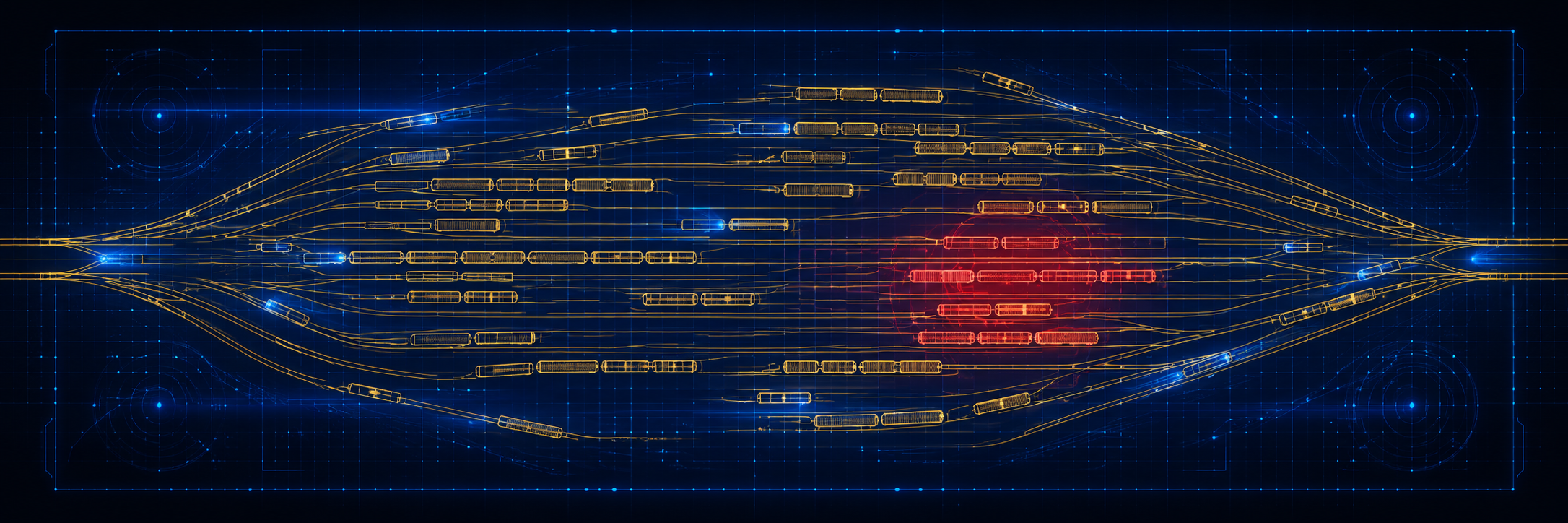
A railcar earns nothing sitting in a yard. Every hour it dwells is capacity parked, service delayed, and capital standing still — and the terminal is where those hours accumulate fastest.
Of all the numbers a Class I railroad watches, terminal dwell is one of the most revealing — revealing enough that railroad terminal dwell reduction analytics has become a lever on capacity that requires no new track at all. It measures the moments when the network is doing the opposite of its job. Train velocity captures a railroad in motion. Terminal dwell captures it standing still — the average time a car spends in a terminal between arrival and departure, waiting to be classified, connected, and sent back out. Every hour counted in that average is an hour a customer’s freight is not moving and a railroad’s asset is not earning.
The economics are unforgiving in their simplicity. A railcar generates value only when it moves; a terminal is where cars stop by design, to be sorted and reassembled into new trains. Some dwell is unavoidable — the work of classification takes time. But the gap between the dwell a terminal requires and the dwell it actually records is pure friction, and it compounds across every car, every terminal, every day. Railroad terminal dwell reduction analytics is the discipline of closing that gap: seeing where the hours are accumulating, understanding why, and giving the operators who run the terminal the information to move cars through it faster.
This is not an abstraction on an executive dashboard. It is the difference between a network that flows and one that quietly congeals, one terminal at a time, until the delays are visible to every customer and the operating ratio tells the story after the fact.
The financial translation is direct. Dwell ties up cars, and cars are capital; a fleet that turns faster does the same work with fewer assets, which is the whole logic behind cost per carload and return on invested capital. A railroad that shaves hours off average terminal dwell is not just running a tidier operation — it is lowering the asset base required to move a given book of business, and doing it without a single dollar of new construction. That is why dwell draws attention all the way to the boardroom: it is one of the few levers that improves service and the operating ratio at the same time.
What is terminal dwell in freight rail?
Terminal dwell is the average time a railcar spends at a terminal between arrival and departure on its next train — a core metric railroads report to the Surface Transportation Board. It captures how efficiently a terminal reassembles cars into outbound trains. High dwell signals congestion or crew and power constraints; reducing it frees capacity without new track.
How railroad terminal dwell reduction analytics finds the hours
A freight network’s performance is decided disproportionately inside its terminals. The line of road is relatively simple: a train moves from A to B. The terminal is where the complexity lives — where inbound trains are broken down, cars are sorted by destination, blocks are rebuilt, power and crews are matched to outbound trains, and the whole intricate dance either flows or backs up. When a network slows, the terminal is usually where it slowed first.
The trouble is that the causes of dwell are distributed across systems that rarely share a screen. A car sits because its outbound train is short a crew, or because the power is not yet assigned, or because an inbound connection arrived late and cascaded, or because the classification track it needs is occupied. Each of those facts lives in a different system, owned by a different desk. Freight rail network performance analytics is the work of pulling them into one view — so that a dwelling car is not just a number rising on a report, but a situation with a visible, addressable cause. The value is in the correlation as much as the data: any one desk can see its own piece, but only a combined picture shows that the crew shortage, the late inbound, and the occupied classification track are one connected event rather than three separate ones. That is the difference between reacting to dwell and understanding it.
Every hour a car sits is capacity, service, and capital standing still. Dwell is not a statistic a railroad reports — it is money the network is not making, measured by the hour.
This is why dwell rewards being watched as it happens rather than reviewed after it accumulates. By the time a monthly average shows a terminal trending the wrong way, the capacity is already lost and the service is already late. Real-time rail terminal visibility changes the timing of the intervention — surfacing the developing congestion while a supervisor can still act on it, reassign a crew, reprioritize a track, or hold a decision that would have made the backup worse.
ReflexOS™ reads a terminal’s live operating signals — inbound consists, car classification status, crew and power availability, outbound build progress — as one picture. It identifies where dwell is building and what is driving it, flags the developing constraint while there is still time to act, and surfaces it for the terminal team’s discussion so they can adjust — reassign power, resequence a build, or clear a connection before the backup cascades. The railroaders run the terminal. The platform makes sure the constraint is visible while the decision still matters.
Used this way, rail network disruption early warning is not a report card delivered after the shift. It is an operating instrument that turns a lagging metric into a leading one — dwell seen forming, not dwell explained afterward. It is one application of the broader real-time operational intelligence for freight rail, the same picture applied across the network rather than a single terminal.
Where the hours hide
Terminal dwell is not one problem with one cause. It accumulates in distinct places, and each rewards being seen as part of the whole rather than managed in isolation.
Where inbound cars wait to be sorted. Railroad asset utilization analytics matters most here, because a classification bottleneck holds cars that every downstream train is waiting on.
A built train with no crew or no power is a train that does not leave. Freight rail scheduling optimization keeps the resource plan and the operating reality reconciled before the mismatch becomes dwell.
One late inbound can miss a dozen outbound builds. Rail freight visibility and risk intelligence catches the cascade early, when a single reprioritization can still contain it.
A terminal’s dwell is shaped by the terminals up and down the line. Defense supply chain rail risk monitoring matters where a railroad moves loads a national supply chain depends on, and a local backup becomes a strategic delay.
Read as one picture, these are the components of a real Class I railroad operational intelligence platform: not four separate dashboards for four separate desks, but a single view of where the network’s time is being spent and where an operator can win it back. The terminals that run best are rarely the ones with the newest infrastructure; they are the ones where the people on the ground can see the whole board at once and act before a small constraint becomes a general slowdown. That visibility is something a railroad can deploy across its network far faster than it can build.
You cannot build your way out of dwell. The capacity is already there, parked in the yard by the hour. The question is only whether you can see it in time to set it moving.
The capacity a railroad needs is often already sitting in its own terminals, measured in dwell. U.S. Aerospace Defense Group works with railroads on the ReflexOS™ operational intelligence platform — reading a terminal’s live signals as one picture so a developing constraint is visible while a supervisor can still act on it, and the network keeps moving. Every hour a car sits is capacity standing still. Keep the network moving.
#FreightRail #ClassIRail #TerminalDwell #RailOperations #RailLogistics #SupplyChain #OperationalIntelligence #RailAnalytics #NetworkVelocity #STB #AssetUtilization #ReflexOS #RiskIntelligence #DefenseSupplyChain #RailTech #SDVOSB #USADG #IntelligenceBrief