
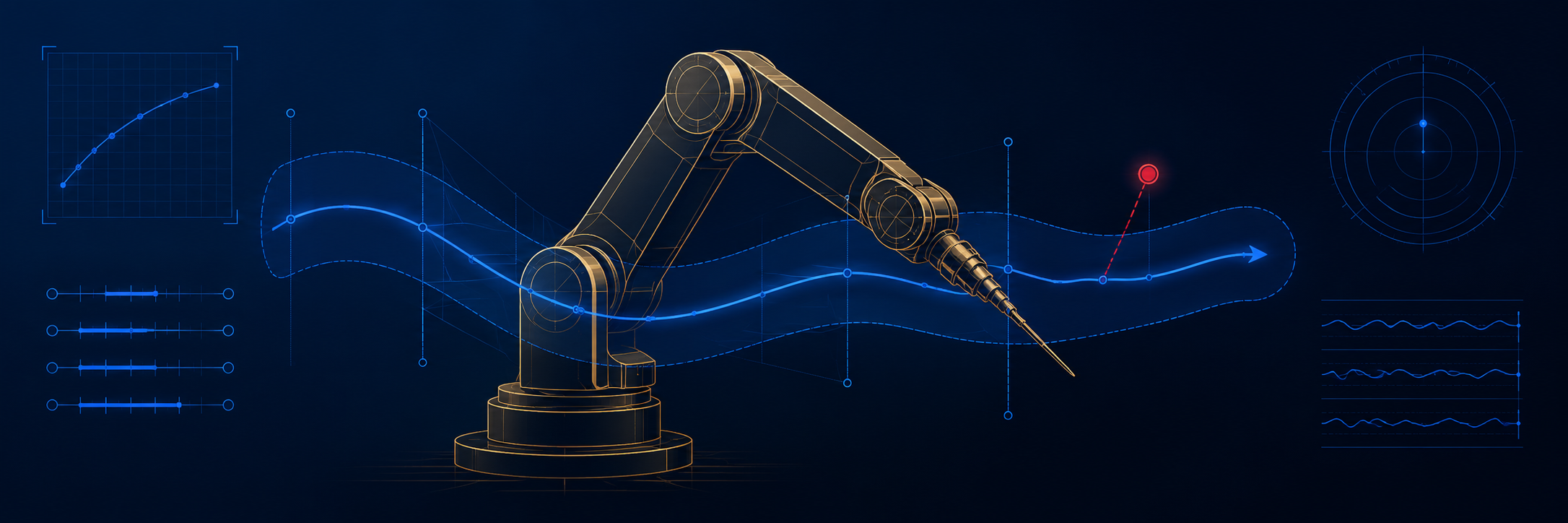
A surgical robot does exactly what it is told, exactly when it is told, every time. That reliability is the entire reason it is trusted in an operating room — and the entire reason a lapse in it is intolerable.
Medical robotics occupies a strange and demanding place in healthcare technology — demanding enough that a medical robotics risk intelligence platform is less a convenience than a condition of trusting the machines at all. A robotic surgical system, an automated pharmacy dispenser, an imaging platform that positions itself around a patient: each is trusted to act in the physical world, near or inside a human body, on the assumption that it will behave predictably. The value of the machine is precisely its consistency. So is the risk.
When the failure mode of a technology is measured in patient harm rather than downtime, the standard it has to meet changes character. It is not enough for the system to work most of the time, or to work on average. It has to behave the same way every time it is given the same instruction, and it has to be possible for the people responsible for it to know that it did. A medical robotics risk intelligence platform exists to hold that standard — to give a hospital or a manufacturer continuous, verifiable insight into whether these systems are behaving as designed, before a deviation reaches a patient.
That is a different job than cybersecurity, and a different job than maintenance, though it touches both. It is the discipline of knowing, at all times, that a system trusted to act autonomously in a clinical setting is still acting the way it was built to.
The need has grown with the fleet. A modern health system may run dozens of robotic and automated platforms across surgery, imaging, and pharmacy — each from a different manufacturer, each with its own service portal, its own alerts, its own definition of normal. Watched one console at a time, the estate is legible only to the specialists who own each device. Watched as a whole, it becomes something a health system can actually govern: one view of every system trusted to act, measured against how each was designed to behave.
What is risk intelligence for medical robotics?
Risk intelligence for medical robotics is the continuous monitoring of robotic and automated clinical systems — surgical robots, automated dispensing, self-positioning imaging — to confirm they operate within their designed parameters and flag deviations before they affect care. It reads a system’s signals against its expected baseline, so a drift or fault is visible to clinical and biomedical teams in time to act.
The kind of AI a hospital can actually trust
There is a quiet fact in the regulatory record that ought to shape every conversation about artificial intelligence in medicine, and it is visible in the FDA’s own data.
The FDA has authorized more than fourteen hundred AI-enabled medical devices — the cumulative count passed 1,451 by the end of 2025 and kept climbing into 2026. And across that entire body of cleared, clinical-grade technology, not one authorized device is powered by a large language model or built on generative AI. The overwhelming majority rely on predictive models: systems that produce a consistent, traceable output from a given input. The kind of AI that has actually been trusted to operate in American medicine is, almost without exception, deterministic.
Every cleared, clinical-grade AI in American medicine produces a consistent output from a given input. In an operating room, that is not a limitation. It is the whole requirement.
The regulatory direction reinforces the point. The FDA now manages these systems across their total product lifecycle, expecting manufacturers to monitor real-world performance and document how a device behaves once it is in the field rather than only at the moment of clearance. That expectation — continuous evidence that a system still performs as authorized — is exactly what a monitoring platform is built to supply. Compliance and safety are converging on the same requirement.
This matters for medical robotics more than anywhere else in the hospital, because a robotic system acts. A diagnostic tool that behaves unpredictably produces a questionable reading a clinician can double-check; a robotic system that behaves unpredictably moves. The premium on determinism — on the system doing the same thing every time, and on that behavior being verifiable — rises exactly as the consequences become physical. A deterministic AI platform for clinical systems is built around that premium rather than against it: the intelligence layer that watches these systems is itself designed to be traceable and consistent, because a monitor a hospital cannot fully trust is not much of a monitor. It is one expression of a broader healthcare technology risk intelligence platform — the same discipline applied wherever a hospital depends on technology behaving exactly as designed.
ReflexOS™ reads a robotic system’s performance and condition data against the behavior it was designed to exhibit. It identifies a drift from expected operation — a positioning deviation, a response outside tolerance, a maintenance signal trending toward failure — flags it to the biomedical and clinical teams while the system can still be checked, and surfaces it for their discussion so the department can adjust: service the unit, take it out of rotation, or clear it for use. It supports the people responsible for the system; it does not overrule them. The decision to use, pause, or service a device stays with the clinical and biomedical staff who own that responsibility.
That boundary is not a disclaimer; it is the design. Clinical AI that supports the judgment of clinicians and biomedical engineers — rather than substituting for it — is the only kind that belongs anywhere near a patient. Connected medical device monitoring platform capability earns its place by making the responsible humans better informed, sooner, not by making decisions on their behalf.
Where a medical robotics risk intelligence platform earns its place
Robotic and automated systems fail in different ways across the hospital, and each rewards being watched as part of one operating picture rather than device by device.
The FDA regulates these as computer-assisted surgical systems, with risk managed across the full product lifecycle. Surgical robotics operational risk monitoring watches performance against design tolerance so a deviation is caught before a procedure, not during one.
Self-positioning imaging platforms move around patients on a schedule of tight tolerances. Predictive maintenance for medical imaging systems keeps a positioning fault from becoming a repeat scan, a delay, or a dose concern.
Robotic dispensing trades a human error mode for a machine one — rarer, but systematic when it occurs. Connected medical device cybersecurity monitoring matters here because a dispensing system is both a safety device and a network endpoint.
Every connected robotic system is also an attack surface. A medical robotics risk intelligence platform reads safety behavior and security behavior together, because for a device that acts on a patient, they are the same question.
Read as one picture, these are the components of a real hospital operational continuity platform for the automated part of the estate: not a maintenance log per device, but a live view of whether every system trusted to act is still acting as designed. The connection to a facility’s broader resilience is direct — the same discipline that keeps a robot behaving keeps a department running, and it shares a foundation with the continuity of care a hospital has to maintain through a cyber incident.
The machine that acts on a patient has to be trusted to act as designed — and trust, in a hospital, is not a feeling. It is something you verify, continuously, or you do not really have.
A system trusted to act on a patient has to be verified, not assumed. U.S. Aerospace Defense Group works with hospitals, health systems, and medical-device manufacturers on the ReflexOS™ platform and its deterministic intelligence layer — continuous, traceable insight into whether robotic and automated clinical systems are still operating as designed, delivered to the biomedical and clinical teams who make the call. Protect the innovation. Preserve the continuity of care.
#MedicalRobotics #HealthTech #SurgicalRobotics #DeterministicAI #PatientSafety #MedTech #ConnectedDevices #ClinicalAI #FDA #MedicalImaging #HospitalOperations #BiomedicalEngineering #ReflexOS #RiskIntelligence #ContinuityOfCare #SDVOSB #USADG #IntelligenceBrief