Your general liability policy contains an exclusion for property in your care, custody or control. If you operate a hangar, that exclusion sits exactly on top of your largest exposure.
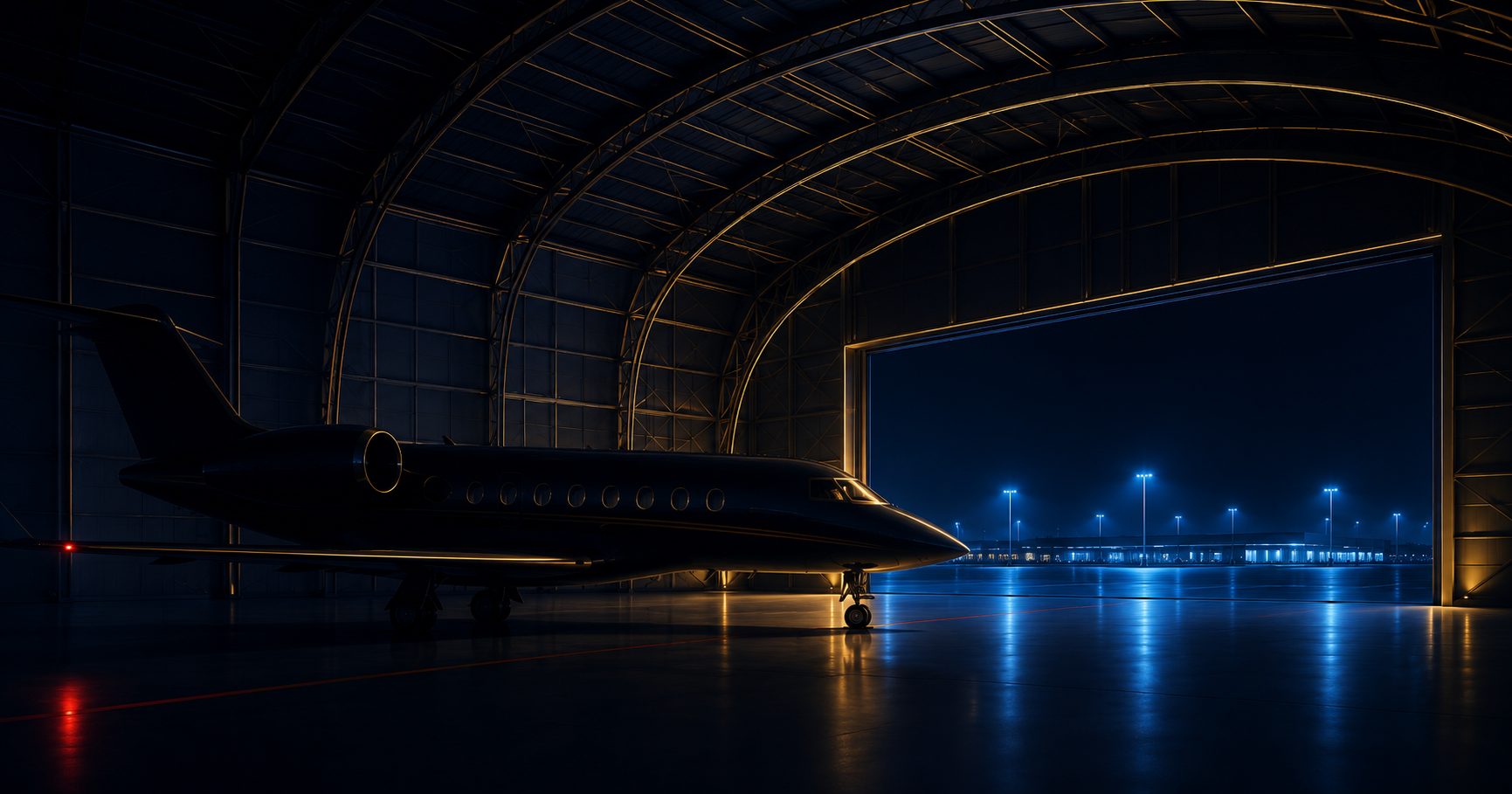
A tug operator misjudges a turn. A wingtip meets a hangar door frame. The aircraft belongs to a customer, it is worth eleven million dollars, and it is in your building because you agreed to keep it there.
Most operators assume the commercial general liability policy handles this. It does not, and the reason is a single clause: hangarkeeper’s liability insurance exists because standard general liability specifically excludes damage to property in your care, custody or control. Everything you are paid to look after is carved out of the policy you assumed was covering it.
What does hangarkeeper’s liability insurance cover?
Hangarkeeper’s liability insurance covers damage to aircraft owned by others while in your care, custody or control — stored in your hangar, parked on your ramp, or undergoing service. It responds to fire, ground-movement collision, hangar rash, falling objects and employee negligence, filling the care, custody and control exclusion in a commercial general liability policy.
Who needs it
The test is not what you call your business. It is whether other people’s aircraft are ever in your possession.
Transient parking, overnight storage, fueling and towing. FBO general liability coverage without a hangarkeeper’s line leaves the core of the operation unprotected — every aircraft on the ramp is in your control the moment you touch it.
An aircraft in for a phase inspection may sit in your hangar for weeks, partially disassembled. MRO general liability insurance and hangarkeeper’s do different jobs — one answers for the work, the other for the airframe while it waits.
Aviation general liability coverage for defense contractors takes on a different character when the airframe belongs to a program. Damage to a government aircraft is not merely a repair invoice — it is a schedule slip on a contract with a delivery date.
A specialty shop can hold a customer’s airframe for weeks — panels open, high-value avionics exposed, the aircraft worth far more than the invoice for the work. Operators who do not think of themselves as full repair stations often carry limits sized to the job, not to the hull sitting in the bay.
The two structures, and why the difference matters
This is the part that gets glossed over in a quote comparison, and it is where two policies that look alike behave completely differently after a loss.
Legal liability form. The policy responds only if you are legally liable for the damage — that is, if negligence can be established. If a hailstorm collapses the hangar roof onto three customer aircraft and nobody was negligent, a legal liability form may not respond at all. The customer’s own hull insurer pays, and then, quite possibly, comes looking for you anyway.
Direct primary form. The policy responds to covered damage regardless of fault. It costs more. It also removes the argument, which is precisely what you are buying — because the argument happens at the worst possible moment, with a customer standing in your hangar looking at their damaged airplane.
Two hangarkeeper’s policies at the same limit can be a factor of ten apart in what they actually pay. The limit is the number people compare. The form is the number that matters.
How the limits are structured
Hangarkeeper’s limits are written two ways at once, and both have to be right.
There is a per aircraft limit and a per occurrence limit. The first caps what the policy pays for any single airframe. The second caps what it pays for one event, no matter how many aircraft that event touches.
The failure mode is easy to describe and expensive to discover. An operator carries a limit sized to the most valuable aircraft it ever handles, which feels prudent. Then a hangar fire involves six aircraft simultaneously, the per-occurrence limit is exhausted well before the individual claims are, and the shortfall lands on the operator. Set the per-aircraft limit against the most expensive airframe you will ever accept. Set the per-occurrence limit against the worst night your hangar could have with everything in it.
One more structural point, because it decides who actually pays. Hangarkeeper’s is excess over the aircraft owner’s own hull policy in most placements — the owner’s insurer pays first, then looks to you for what it paid. That subrogation claim is the real-world shape of most hangarkeeper’s losses, and it is why the limit needs to contemplate not just the damage but the recovery action that follows it. A hangar lease or service agreement will often try to shift that burden by contract; whether your policy actually responds to a liability you assumed in writing depends on how the contractual liability language is drafted, and it is worth reading before signing rather than after.
The coverage also has edges worth knowing before a claim finds them: aircraft in flight generally fall outside it, subcontracted work may not be picked up, and aircraft left on the field after hours can raise questions about whether they were in your custody at all. None of these are unusual. All of them are worth resolving at placement rather than at loss.
A hangarkeeper’s limit is usually set once and revisited at renewal, while the exposure underneath it changes constantly — a new customer with a larger aircraft, a busier season, a hangar packed tighter than it was in March. ReflexOS™ supports proactive liability exposure monitoring for contractors by reading what the operation already records — movements, storage, work in progress — and surfacing the point at which the values on the field have outgrown the limit on the policy. Identify the drift. Flag it. Discuss it with your broker. Adjust deliberately, before the busiest night of the year is also the night you find out.
Placing it properly
Hangarkeeper’s is rarely bought alone. It sits alongside premises liability for the facility itself, products and completed operations if you perform work, and the broader aviation general liability program that responds when the injury is to a person rather than an airframe. Written separately by separate parties, those policies develop gaps between them — and the gap is always discovered by a claim.
USADG is a specialized independent insurance broker to the aviation, aerospace and defense community. It places and structures hangarkeeper’s and aviation liability programs with A-rated underwriting partners, and it advocates for clients on claims. The value in a specialist is knowing which form to write, where the per-occurrence limit should sit for your actual operation, and which endorsements close the seams between policies before anyone needs them to. The lines are set out on the USADG coverage page.
Nobody reads the care, custody and control exclusion until the wingtip is already bent. It has been in the policy the whole time, doing exactly what it says.
U.S. Aerospace Defense Group places and structures hangarkeeper’s, aviation general liability and products programs for FBOs, repair stations and defense support operations, working with A-rated underwriting partners — with the form, the limits and the endorsements set against the operation you actually run. The ReflexOS™ overlay keeps the exposure picture current between renewals.
#HangarkeepersLiability #AviationInsurance #AviationGeneralLiability #FBO #MRO #RepairStation #CareCustodyControl #AircraftInsurance #HangarRash #AviationRisk #DefenseContractor #GovCon #InsuranceBroker #AviationSafety #ReflexOS #SDVOSB #USADG #IntelligenceBrief