
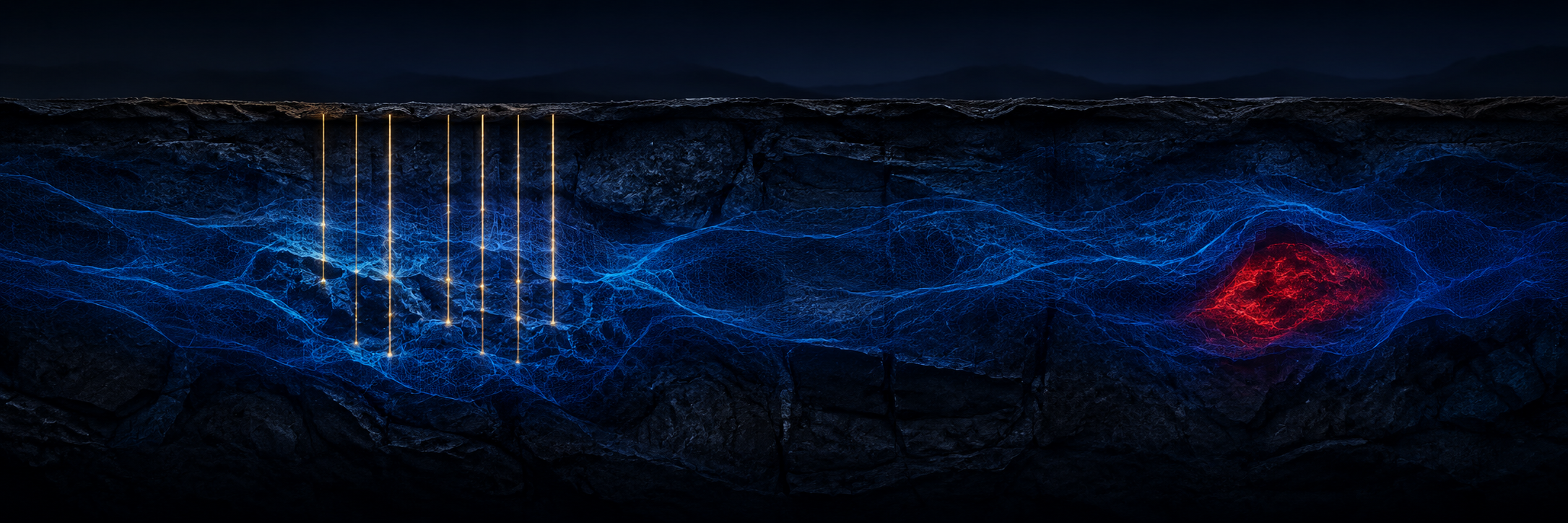
The seller has drilled the property. The seller has the data. The seller has every reason to show you the best of it — and no obligation to show you the rest.
A mining acquisition is a decision made on someone else’s information — which is why technical due diligence for mining acquisitions is where a disciplined buyer earns or loses the deal. The buyer of a land package, a claim, or a development-stage asset is looking at a data room the seller assembled — the holes the seller chose to drill, in the places the seller chose to drill them, presented the way the seller chose to present them. None of that has to be dishonest to be incomplete. It only has to be selective, and selection is the seller’s prerogative.
This is the structural problem that technical due diligence for mining acquisitions is meant to solve: the buyer and the seller are working from the same drill logs, and the buyer has no independent line of sight into the ground beneath the parts of the property nobody chose to drill. Confirmation is available. Independent evidence, gathered by the buyer rather than inherited from the seller, usually is not.
For a buyer committing real capital, that asymmetry is the whole risk. The value of the asset lives underground, where neither party can see it directly — and the party who has been looking longest is the party across the table.
What is technical due diligence in a mining acquisition?
Technical due diligence in a mining acquisition is the independent assessment of an asset’s geological and physical characteristics — separate from the legal review of ownership. It is the work of verifying, from evidence the buyer controls, what the ground supports, so a purchase decision rests on more than the data the seller elected to share.
Technical due diligence for mining acquisitions starts where the data room ends
Every seller’s data room is a curated document. The drill holes it contains are real, the assays are real, the maps are real — and they describe, with complete accuracy, exactly the parts of the property the seller was most motivated to characterize. The holes that were never drilled leave no record, and their absence is the most important thing in the room that isn’t in the room.
An independent geophysical assessment for mining acquisitions changes what the buyer brings to the table. Instead of re-reading the seller’s holes, the buyer can develop an independent read of the subsurface across the whole property — including the ground the seller’s drilling never touched. It does not contradict the data room; it surrounds it, putting the seller’s holes in a context the seller did not supply.
A data room tells you what the seller found. It does not tell you what the seller looked for and chose not to mention. Independent evidence is the difference between the two.
This is why third-party subsurface verification has value precisely at the moment of transaction. Before capital is committed, an independent line of sight into the property is worth more than any assurance the seller can offer, because it is the one input in the process the seller did not shape.
What independent evidence can and cannot settle
The value of independent subsurface evidence is in what it adds to the buyer’s own analysis, and it is worth being exact about what that is.
The USADG quantum sensing platform is designed to give a buyer an independent read of a property’s subsurface. The 6-channel quantum sensor is engineered to detect subsurface anomalies at depths of up to 15 km — physical-property variations that a curated set of drill holes cannot, by itself, reveal. That evidence becomes an input to the buyer’s own technical team and the qualified professionals who produce the formal geological and reserve assessments a transaction requires. It sharpens their picture; it does not substitute for their determinations, and it produces no verdict of its own about what the property holds. The point is not to hand a buyer a conclusion — it is to make sure the buyer’s own experts are working from more than the seller elected to disclose, so that the assessment they sign rests on the widest evidence base available rather than the narrowest.
ReflexOS™ is built to bring an independent subsurface read together with the seller’s disclosed data in one picture. The design identifies where the independent evidence agrees with the data room and where it diverges from it, flags the areas the disclosed drilling never characterized, and surfaces both for the buyer’s technical team to discuss so the diligence process can adjust — targeting confirmatory work where it matters most. The judgment stays with the qualified people who sign the assessment. The platform’s role is to make sure the buyer’s team is looking at more than the seller chose to show.
Used this way, pre-acquisition subsurface intelligence is not a second opinion on the seller’s numbers. It is a first opinion the buyer owns — independent evidence gathered on the buyer’s behalf, feeding the buyer’s own qualified assessment of the asset. The survey capability behind it is described in the critical mineral subsurface mapping platform, and the drilling economics that make a property worth developing after it is acquired are set out in reduce dry holes in mineral exploration.
The distinction matters most in the way it changes a negotiation. A buyer working only from the data room can question the seller’s holes but cannot go beyond them; every point of leverage is a point the seller already anticipated. A buyer with an independent read of the whole property can ask a different class of question entirely — about the ground the disclosed program avoided, and why. That is not an accusation. It is simply the buyer knowing something the data room was not built to tell them.
Where independent evidence changes the deal
The buyer’s need for an independent line of sight shows up differently depending on what is being acquired and how far along it is.
Where the seller’s data is thinnest and the buyer is paying largely for potential. Mineral property technical assessment input matters most here, because there is the least disclosed drilling to lean on and the most unmapped ground.
Where a data room is substantial but built to support a sale. Independent verification for mining transactions lets a buyer test the property beyond the boundaries of the seller’s chosen program.
Where a disciplined buyer runs a formal diligence process. Technical due diligence for mining acquisitions becomes an independent input line the investment committee controls, rather than one inherited from the seller.
Where a buyer is acquiring a source for its strategic value. Independent subsurface evidence supports a decision that a defense-relevant supply chain may ultimately depend on.
Across all of them the principle is the same: the buyer who brings independent evidence to the table is negotiating from a different position than the buyer who brings only the seller’s. One is reacting to a curated document; the other is testing it. And the cost of that independent read is small against the size of the decision it informs — a diligence expense measured against a capital commitment measured in multiples of it. For a buyer about to price an asset on what lies underground, the question is not whether independent evidence is worth obtaining. It is whether committing the capital without it was ever the disciplined choice.
Every mining deal is priced on what is underground. The buyer who can see it independently, before the wire goes out, is the only one at the table not taking the seller’s word for it.
A mining acquisition is priced on ground only the seller has seen. U.S. Aerospace Defense Group gives buyers an independent line of sight — the quantum sensing platform designed to develop subsurface evidence across a whole property, and the ReflexOS™ picture that sets that evidence against the seller’s disclosed data — so a diligence team commits capital on more than the data room it was handed. If you have a live transaction, the time to see the ground independently is before the deal closes.
#MiningAcquisitions #TechnicalDueDiligence #MiningMA #MiningPE #CriticalMinerals #Geophysics #SubsurfaceIntelligence #IndependentVerification #MiningInvestment #QuantumSensing #ReflexOS #MineralExploration #DomesticSupply #ResourceSecurity #SDVOSB #USADG #IntelligenceBrief