
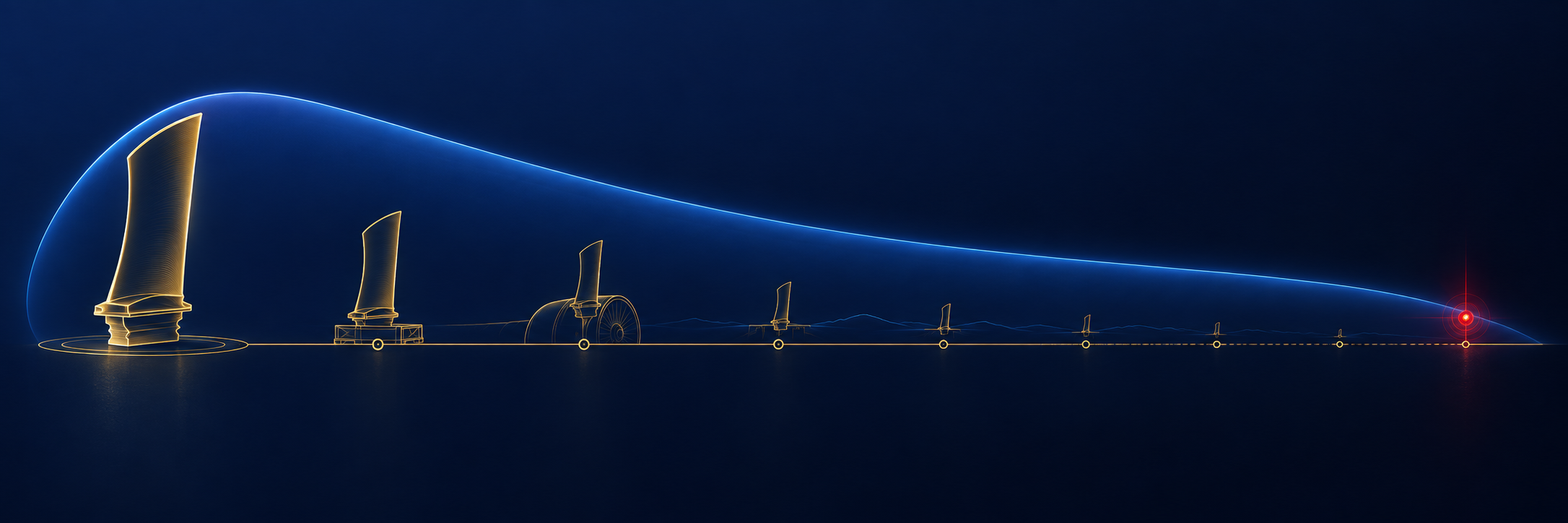
A part leaves your factory and stops being something you can see. It does not stop being something you are responsible for. Aerospace products liability is the coverage for the years in between.
Most liability a business carries is tied to a place and a moment: someone is hurt on your premises, an operation goes wrong on your watch. Aerospace products liability insurance is the exception — the coverage for a risk that has left the building. Products liability is different, and for an aerospace manufacturer or component supplier it is the exposure that behaves least like the others. The thing that creates the risk — a part, an assembly, a system — leaves your control the day it ships, and then keeps generating potential liability for as long as it is in service. Which, in aerospace, can be decades.
That is what makes aerospace products liability insurance its own discipline rather than a line item inside a general policy. The claim, when it comes, may involve a component you manufactured years ago, installed in an aircraft you never saw, operated by an entity you have no relationship with, in a jurisdiction you have never done business in. The exposure outlives the sale, travels farther than the company, and surfaces on a timeline no one controls. A program built for premises-and-operations risk is not built for that.
For the companies advancing aerospace and defense capability — the manufacturers, the suppliers, the subassembly makers feeding the primes — this is frequently the largest and least-understood exposure they carry. Understanding how it is structured, and where the gaps hide, is not an insurance formality. It is a core part of protecting the business.
What does aerospace products liability insurance cover?
Aerospace products liability insurance covers a manufacturer’s or supplier’s legal liability for injury or damage caused by a product after it has left their control — a component, system, or aircraft that fails in service. It pairs with completed-operations coverage and responds to claims arising years after the sale, across jurisdictions, for products the maker no longer possesses.
The exposure that outlives the sale
The defining feature of products liability is time. A premises claim happens now; a products claim can happen at any point across the service life of what you built. An aircraft component certified and installed today may still be flying in twenty years, and for all twenty of those years the entity that made it carries a tail of potential liability. This is the long tail that makes the coverage distinctive, and it is where the most expensive surprises live.
It is also why completed operations coverage for aerospace manufacturers is not an optional companion to products liability but part of the same exposure. Completed operations responds to claims arising from work already finished and products already delivered — precisely the window in which an aerospace product spends the vast majority of its life. A program that covers the manufacturing but thins out on the years afterward has left the largest part of the timeline exposed.
A premises claim asks what happened on your property today. A products claim asks what happened to something you built, somewhere you have never been, years after you sold it. The coverage has to reach that far.
The distance the exposure travels is the other half of the problem. An aerospace product can generate a claim anywhere it operates, under any jurisdiction’s law, involving parties the manufacturer has no contractual relationship with. Aircraft component supplier liability insurance has to contemplate that reach — a claim structured in a legal system the supplier never chose, over a product they cannot inspect, on facts they may learn about only when the demand arrives. Structuring a program against that is not a matter of buying a limit. It is a matter of understanding the specific ways a specific company’s products can come back.
Where the gaps hide
Products liability programs fail in characteristic places — not usually in the headline coverage, but in the seams around it. Each of these is a place where a manufacturer can believe it is covered and discover otherwise only when a claim tests the language.
Grounding liability coverage for manufacturers addresses one of aerospace’s signature exposures: a defect that grounds not one aircraft but an entire type, turning a single component failure into a fleet-wide loss. It is a coverage question most general programs never contemplate.
Failure to warn liability coverage matters because a products claim is not only about whether the part was defective — it can turn on whether the maker adequately warned of a known limitation. The exposure lives in documentation as much as in engineering.
General liability insurance for defense contractors deep in a supply chain has to account for exposure that flows up and down the chain through indemnity and hold-harmless terms — obligations a subassembly maker may have accepted without fully pricing the liability.
Contractors whose people or products operate overseas often carry general liability and Defense Base Act coverage together, and the boundary between them is a classic place for a gap to open when a loss does not fit neatly in either.
None of these are exotic. They are the ordinary seams of an aerospace products program — and the reason placing one well takes a broker who recognizes the exposure in the specific business rather than fitting it to a generic form.
Because a products exposure changes as the business changes — a new part, a new customer, a new market, a new certification — ReflexOS™ keeps the risk profile current between renewals. It identifies where what the company now makes or sells has moved beyond the program placed against it, flags the divergence, and surfaces it for a discussion between the client, the USADG broker, and the underwriting partner so the coverage can adjust. This is predictive liability risk management in practice: surfacing an exposure while it can still be addressed, not after a claim reveals it. It does not underwrite the risk or prevent a claim; it makes sure the program keeps pace with the business.
That is the difference a specialist broker makes on a products program: not a bigger limit bought blind, but a program structured around how this company’s products actually move through the world — and kept current as they do.
Products liability is not aviation general liability
It is worth being precise about where this sits, because the terms are often used loosely. Aviation general liability covers the premises-and-operations exposures of an aviation business — what happens at the hangar, on the ramp, in the course of operations. Products liability covers what happens because of the thing you made, after it has left. A complete aerospace program usually needs both, structured so the two fit together without a seam between them — because a loss involving a delivered product on a manufacturer’s own premises can raise both at once. The same seam-management applies to an aviation business’s care of aircraft it does not own, the subject of hangarkeeper’s liability insurance — different exposure, same discipline of closing the gaps between coverages.
Getting that fit right is the work. Aerospace manufacturer liability coverage is rarely a single policy; it is a structure, assembled from the coverages that match how a specific company designs, builds, delivers, and supports what it makes. The value a broker adds is in seeing the whole structure — and the gaps between its parts — rather than any one piece of it.
The part you shipped a decade ago is still out there. A products program is the acknowledgment that your responsibility for it did not end at the loading dock — and the plan for the day it comes back.
A products exposure that outlives the sale needs a program built for the whole timeline, not just the moment of manufacture. U.S. Aerospace Defense Group structures aerospace products and completed-operations programs around how your products actually move through the world — placed with the right underwriting partners and kept current between renewals as your line of work changes.
#AerospaceInsurance #ProductsLiability #GeneralLiability #AviationInsurance #DefenseContractors #CompletedOperations #ManufacturerLiability #GroundingLiability #RiskManagement #AerospaceManufacturing #ReflexOS #GovCon #SupplyChainRisk #SDVOSB #USADG #IntelligenceBrief